
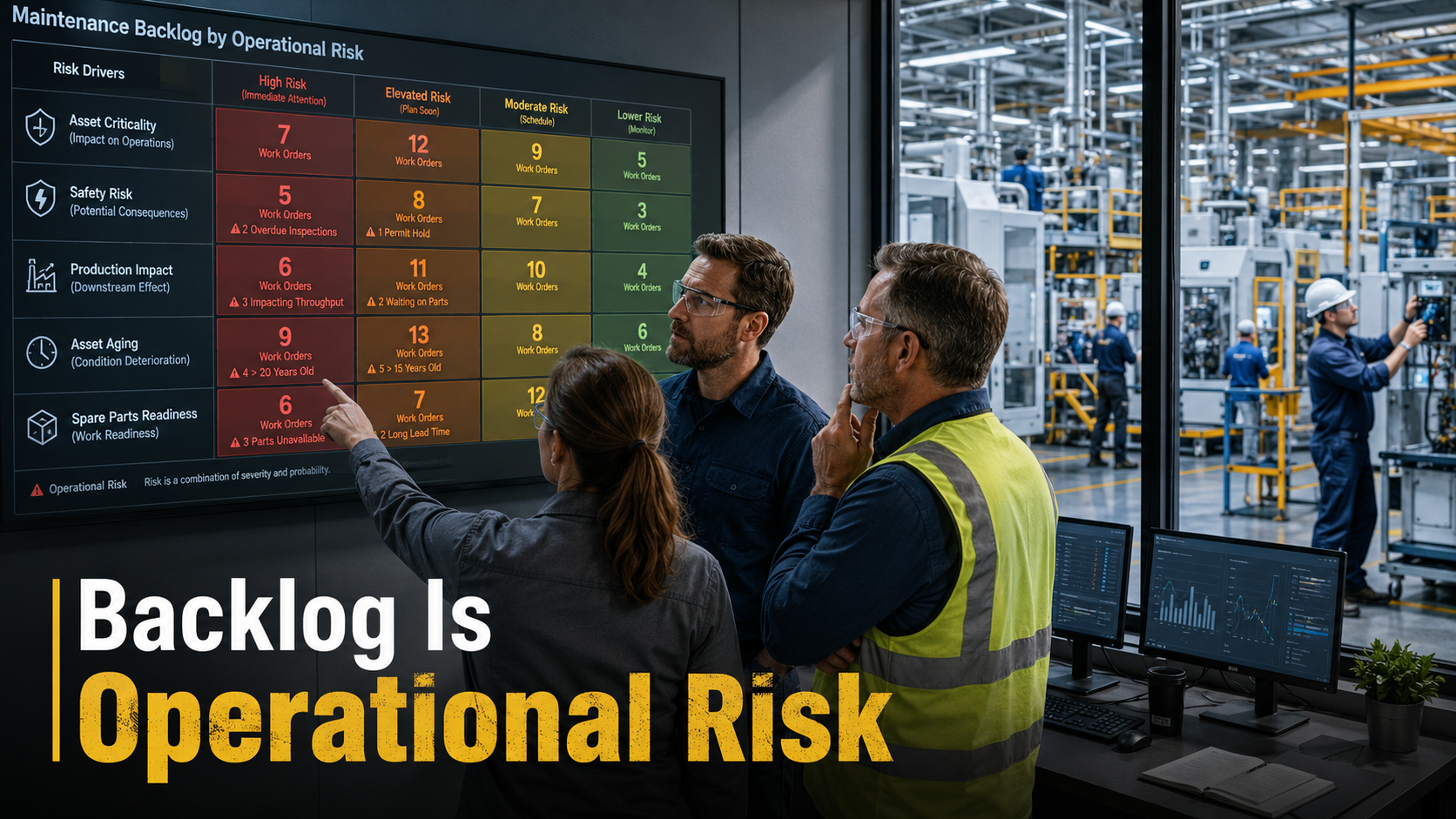
In many maintenance meetings, backlog is still treated primarily as a workload problem.
How many work orders are open?
How many hours are pending?
How many tasks are overdue?
How many jobs are waiting for spare parts, shutdown windows, or production release?
These are legitimate questions. A maintenance organization needs visibility of workload, planning capacity, and execution constraints. However, these questions are not sufficient.
A maintenance backlog is not simply a list of tasks waiting to be executed. It is also a visible expression of operational risk that the organization has not yet resolved.
Some backlog is normal. No industrial site can execute every task immediately. There will always be planned interventions, inspections, minor improvements, corrective actions, and preventive work waiting for the appropriate window.
The problem begins when backlog becomes a repository of postponed decisions.
A vibration anomaly remains open.
A leak is accepted as “not urgent.”
A temporary repair waits indefinitely for a permanent solution.
A recurring failure is not analysed.
A safety-related condition remains blocked by missing parts.
A preventive task is deferred because production pressure is too high.
At that point, the relevant question is no longer only:
How much backlog do we have?
The more important question is:
What risk are we carrying because this work has not been executed, reviewed, escalated, or formally accepted?
Not All Backlog Has the Same Meaning
Backlog should never be treated as one homogeneous mass.
A cosmetic repair on a non-critical asset is not equivalent to a repeated fault on a bottleneck machine. A low-risk improvement waiting for engineering support is not equivalent to a temporary fix on a safety-critical system. A planned task awaiting a scheduled shutdown is not equivalent to an overdue inspection on equipment with known degradation.
Yet many backlog reviews still focus on aggregated indicators:
total open work orders, total overdue hours, total backlog weeks, planned versus unplanned work, or percentage of completed tasks.
These indicators are useful, but they can also hide risk. A plant can reduce the number of open work orders and still leave the most important risks unresolved. Conversely, a large backlog may be manageable if it is well segmented, actively reviewed, and governed by clear decision rules.
The mature question is not simply:
How do we reduce backlog?
It is:
Which backlog must not be allowed to age, and which risks require explicit ownership?
This distinction matters. Backlog volume describes workload. Backlog composition describes exposure.
The Risk of Aging Backlog
Backlog becomes more dangerous when it ages without technical review.
A work order opened three months ago may no longer represent the same asset condition. The defect may have deteriorated. The temporary fix may have become accepted practice. The original diagnosis may be incomplete. Production requirements may have changed. The spare part may still be unavailable. The risk may have increased without being formally reassessed.
Old backlog is not always low priority. Sometimes it is simply forgotten risk.
This happens easily in real factories. A technician identifies a defect. The line continues running. A work order is created. Production has no available window. Maintenance waits. Planning moves the task. A supervisor changes. The equipment keeps operating. The same symptom appears again, perhaps under a slightly different description.
After a while, the organization stops seeing the work order as a warning signal.
It becomes background noise.
This is one of the most subtle ways in which operational risk becomes normalized. The asset is still running, so the organization assumes that the condition is acceptable. But continued operation is not the same as controlled risk.
Backlog Reveals the Quality of the Decision System
A maintenance backlog is often a mirror of how the organization makes decisions under pressure.
If many work orders contain vague descriptions, the weakness may be work identification.
If many jobs are blocked by materials, the weakness may be spare parts strategy, supplier reliability, or inventory governance.
If work waits repeatedly for production release, the weakness may be production-maintenance coordination.
If repeated failures remain open, the weakness may be root cause discipline.
If planned work is constantly postponed, short-term output pressure may be overriding asset health.
If jobs are technically complete but not closed, the weakness may be CMMS discipline and data quality.
If everything is marked urgent, the weakness is not workload; it is prioritization maturity.
Backlog is therefore not only a maintenance problem. It is a cross-functional signal.
It shows how production, maintenance, planning, engineering, procurement, logistics, quality, safety, and leadership make trade-offs. It also shows whether those trade-offs are governed, documented, and reviewed — or simply absorbed into the daily noise of the plant.
This is why backlog management should be seen as part of operational governance, not only as a maintenance planning activity.
The Trap of “Cleaning the Backlog”
Many organizations launch backlog reduction campaigns. The intention is usually reasonable: recover control, improve CMMS discipline, reduce old work orders, and make planning more reliable.
However, there is a common trap.
If the objective is only to reduce the number, the system will find ways to reduce the number.
Duplicate work orders are removed.
Old tasks are cancelled.
Descriptions are corrected.
Low-priority jobs are deleted.
Some work is grouped.
Some tasks are moved into future plans.
Some of this is necessary. Backlog hygiene matters. A CMMS full of obsolete, duplicated, or poorly described work orders does not support good execution.
But administrative cleanup is not the same as risk reduction.
The real test is simple: after the cleanup, is the plant safer, more reliable, and better controlled? Or does the KPI merely look better?
A serious backlog review must distinguish between administrative waste and unresolved technical risk. Otherwise, the organization may improve the indicator while leaving the asset condition unchanged.
Prioritization Is the Core Discipline
Backlog management is fundamentally a prioritization discipline.
Many sites use priority codes such as emergency, urgent, high, medium, and low. The problem is that these categories are often applied inconsistently. Production wants its issue prioritized. Maintenance wants to protect critical assets. Quality wants to prevent defects. Safety cannot be compromised. Planning wants stable execution. Finance wants cost control. Engineering wants permanent solutions.
All these perspectives are legitimate. The problem is not that different functions have different priorities. The problem is the absence of a transparent decision model.
A useful prioritization system should consider, at minimum, asset criticality, safety exposure, quality impact, production consequence, likelihood of failure, degradation speed, customer exposure, spare parts availability, execution duration, and opportunity windows.
Without this logic, prioritization becomes negotiation.
And negotiation under pressure usually favours the loudest problem, not necessarily the most important risk.
Production Pressure Is the Real Test
The real test of backlog governance appears when production is under pressure.
A machine has a known defect, but the plant needs output.
A planned intervention is ready, but the line cannot stop.
A temporary repair is holding, so the permanent fix is delayed.
A condition monitoring alert recommends action, but the next window is too far away.
A planner requests access, but production asks to defer again.
This is where maintenance becomes a decision system.
Production pressure is real. No serious maintenance professional should ignore delivery commitments, customer demand, or the economic reality of stopping a line. Postponing maintenance can sometimes be the correct decision.
But it should be a decision, not a habit.
When maintenance work is deferred, the organization should understand the consequence. What could fail? How soon? What would be the impact on safety, quality, delivery, cost, or asset life? What monitoring is required? What is the next committed intervention window? Who accepted the risk? What is the escalation rule if the condition deteriorates?
If these questions are not answered, backlog is not being managed.
It is being tolerated.
CMMS and EAM Data Quality Are Operational Disciplines
A CMMS or EAM system can support backlog management only if the data is useful.
A work order with a poor description does not support prioritization.
A missing asset hierarchy hides criticality.
An incorrect failure code weakens reliability analysis.
An unclear status creates confusion.
A closed work order without technical feedback destroys learning.
A backlog report without risk segmentation becomes administrative noise.
The CMMS should not be treated as a database where work orders wait. It should function as a decision platform for maintenance, reliability, and operational control.
That requires discipline.
Technicians need to capture useful observations. Planners need to structure work clearly. Supervisors need to review aging, priority, and readiness. Reliability teams need to analyse repeated patterns. Production and maintenance need shared visibility of risk. Leaders need to ask better questions than: “How many open work orders do we have?”
Data quality is not an IT issue.
It is operational discipline.
Backlog as a Reliability Learning System
A well-managed backlog can become a powerful source of reliability learning.
It can reveal assets with chronic defects.
It can expose recurring temporary repairs.
It can show weaknesses in spare parts strategy.
It can identify planning bottlenecks.
It can reveal poor access to equipment.
It can highlight tasks that should become preventive or condition-based.
It can show where engineering redesign is required.
It can indicate where operator care standards are weak.
However, this learning only occurs when backlog is reviewed as operational intelligence, not as administration.
The best maintenance teams do not only ask what is pending. They ask what the pending work reveals about the asset system.
Why are these tasks waiting?
Why are these failures recurring?
Why are these parts unavailable?
Why are these windows repeatedly missed?
Why are these temporary repairs still open?
Which backlog items require engineering, not another maintenance intervention?
These questions move the conversation from workload control to reliability improvement.
What Leaders Should Ask
Leaders should be careful not to reduce backlog management to a pressure campaign.
If they only ask maintenance to lower the number, the system will find ways to lower the number. If they ask what risk is hidden inside the backlog, the quality of the conversation changes.
Stronger leadership questions include:
Which backlog items could affect safety, quality, delivery, cost, or asset life?
Which work orders are aging without a clear decision?
Which tasks are repeatedly postponed because of production pressure?
Which temporary fixes are becoming permanent operating conditions?
Which spare parts constraints are increasing operational exposure?
Which repeated issues indicate a reliability problem rather than a workload problem?
Which backlog items require cross-functional decision-making?
These are not only maintenance questions. They are governance questions.
They clarify ownership, escalation, decision rights, and risk acceptance.
Backlog Is a Decision Backlog
The most dangerous backlog is not always the largest one.
It is the one nobody truly owns.
A large backlog can be manageable if priorities are clear, risks are visible, execution is planned, and decisions are governed. A smaller backlog can still be dangerous if it contains unreviewed critical risks, old temporary repairs, repeated defects, and postponed decisions.
Every open work order represents a decision: execute, defer, monitor, cancel, redesign, combine, escalate, or formally accept the risk.
The maturity of a maintenance organization is visible in how consciously those decisions are made.
Backlog is not just pending work. It is the accumulated consequence of what the organization has not yet resolved.
And when it is not governed, it becomes operational risk waiting for the wrong moment to appear.
#IndustrialMaintenance #Reliability #AssetManagement #MaintenanceBacklog #OperationalExcellence #CMMS #EAM #MaintenancePlanning #ManufacturingExcellence #ProductionMaintenance #SmartFactory