Many companies assign process owners. Far fewer create real process ownership.
The difference is not semantic. It becomes visible the first time the process breaks under pressure.
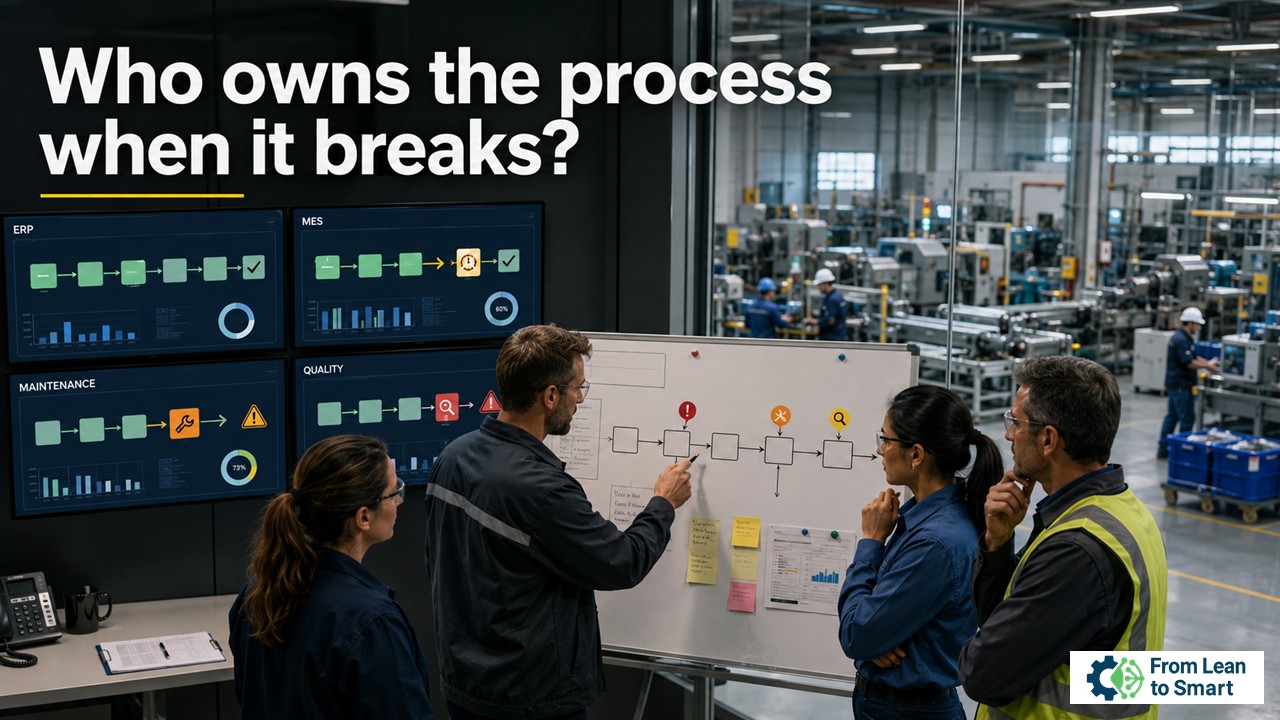
A quality deviation appears during production. A maintenance intervention is delayed because the spare part is not available. Planning changes the sequence to protect customer delivery. The MES shows one operational status, the ERP another, and the team leader has a third version based on what is actually happening at the line.
At that moment, the organization usually asks a simple question:
Who owns this process?
Very often, the answer is uncomfortable. The process has an owner in the repository, but no one truly owns the operational consequences of how the process behaves in real life.
Ownership Is Not Documentation
In many organizations, process ownership starts and ends with documentation. Someone maintains the process map, approves the procedure, attends audits, and updates the workflow when changes are requested.
That work matters. But it is not process ownership.
A documented process can be clean, logical, and compliant while the real operation remains fragmented, unstable, and dependent on informal coordination. The process map may describe the ideal flow, while the shopfloor operates through phone calls, local shortcuts, escalation habits, and tacit knowledge.
This is where BPM often loses contact with operational reality.
A process owner should not only own the diagram. They should own the performance, stability, exceptions, decision rules, data dependencies, and improvement of the process across functions.
That is a much harder role.
Real Processes Cross Functional Borders
Most industrial problems do not respect departmental boundaries.
A production delay may start with material availability, continue with a planning decision, become a changeover issue, create quality risk, affect maintenance priorities, and end as a customer escalation. On paper, each department may have done its part. Operationally, the process has failed as a system.
This is one of the main reasons process ownership fails: organizations assign ownership inside functions, while value flows across functions.
Production owns output. Quality owns nonconformities. Maintenance owns asset availability. Supply chain owns materials. Engineering owns standards. IT owns systems.
But who owns the end-to-end process when the handoffs between all of them create the loss?
If ownership is not designed around the operational flow, it becomes a polite fiction. Everyone is accountable for their part. No one is accountable for the behavior of the process as a whole.
The Process Owner Without Authority
Another common failure is appointing a process owner without giving that person real influence.
They are expected to improve the process, but they cannot challenge priorities. They are asked to standardize decisions, but they cannot change routines. They are responsible for performance indicators, but they do not control the systems, master data, or behaviours that generate those indicators.
This creates an organizational contradiction: the process owner becomes visible when the process fails, but remains invisible when the decisions that shape the process are made.
In real operations, ownership requires access to decision forums. It requires the authority to ask uncomfortable but necessary questions:
Why do we keep accepting this workaround?
Why does the same exception appear every week?
Why does the process depend on one experienced planner, one maintenance supervisor, or one quality technician?
Why do we measure compliance with the process, but not the operational cost of deviating from it?
Without that authority, the process owner becomes a coordinator of frustration.
Exceptions Reveal the Real Process
Many process governance models treat exceptions as noise. In factories, exceptions often reveal how the operation actually works.
A production order is released late, but the team still delivers because someone manually adjusts the sequence. A maintenance work order is closed in the CMMS, but the real fix is still pending. A quality hold is bypassed through informal approval because the customer shipment is urgent. A planner changes the schedule outside the system because the official workflow is too slow.
From a BPM perspective, these may appear to be deviations.
From an operational perspective, they may be signals of weak process design, unclear decision rights, poor system integration, unstable standards, or unrealistic planning assumptions.
The process owner’s role is not to eliminate every exception blindly. Some exceptions are legitimate forms of operational flexibility. Others are hidden process failures being absorbed through local effort.
The difference matters.
Understanding that difference requires gemba, data, and judgement. It also requires a process owner who is close enough to daily operations to distinguish between necessary adaptation and recurring dysfunction.
Systems Do Not Solve Ownership Gaps
ERP, MES, CMMS, QMS, and workflow tools can make process issues more visible. They can also make ownership gaps more painful.
When systems are implemented without clear process ownership, technology exposes contradictions that were previously handled informally.
Who decides the official reason code for downtime?
Who owns the maintenance priority when production pressure conflicts with asset risk?
Who validates whether a process deviation is acceptable or must trigger containment?
Who maintains the master data that defines routings, equipment hierarchy, inspection plans, work centres, escalation logic, or maintenance strategies?
If these questions are not answered, digitalization does not create process control. It creates digital confusion.
The system may automate the workflow, but it cannot replace governance. It cannot decide who has authority, which standard prevails, how exceptions are escalated, or how conflicting priorities are resolved.
A digital process without ownership is not a controlled process. It is an automated ambiguity.
Process Ownership Must Reach Daily Management
A process is not owned in a steering committee. It is owned in the rhythm of operations.
This means process ownership must be connected to daily management, escalation routines, performance reviews, deviation analysis, master data governance, and continuous improvement. Otherwise, ownership remains too far from the place where problems are created and solved.
A useful process owner should be able to identify recurring patterns:
The same approval delay every Monday.
The same production-maintenance conflict every time demand increases.
The same quality containment loop after engineering changes.
The same manual correction after every schedule adjustment.
The same process mining finding repeated month after month without operational action.
This is where BPM becomes valuable: not as a static repository of workflows, but as a management discipline for connecting process reality with operational decisions.
Process mining, MES data, CMMS history, quality records, and escalation logs can all help reveal how the process behaves. But visibility alone is insufficient. Someone must have the mandate to convert that visibility into decisions, standards, and sustained improvement.
What Stronger Ownership Looks Like
Stronger process ownership is not about creating more bureaucracy. It is about making accountability operational.
A mature process owner understands the process model, but also understands how work behaves under pressure. They know the systems, but they also know the workarounds. They review KPIs, but they also ask which decisions those KPIs are changing.
They do not own every task. They own the coherence of the process.
That means clarifying decision rights, aligning functional priorities, governing exceptions, removing recurring friction, protecting standards from erosion, and ensuring that improvements survive beyond the workshop, audit, or transformation initiative.
In practical terms, stronger process ownership requires clear answers to several questions:
Who owns the end-to-end process outcome?
Who owns the critical decisions inside the process?
Who owns master data and system rules?
Who reviews recurring deviations?
Who has authority to change standards?
Who ensures that lessons learned become part of the operating model?
These questions are not glamorous. But they are the questions that make BPM real.
The Real Test
The real test of process ownership is not whether the process has an owner in the repository.
The real test is what happens when the process breaks.
Does the organization understand the cause, or does it only chase symptoms?
Are exceptions reviewed as learning opportunities, or hidden as local heroics?
Can the process owner influence the decisions that shape performance?
Do ERP, MES, CMMS, and local practices reinforce one operational version of reality, or do they create parallel versions of the truth?
Are improvement actions sustained, or do they disappear after the next production crisis?
Process ownership fails when it is reduced to documentation, coordination, or compliance.
It works when it becomes a management capability: a way to connect people, systems, decisions, data, standards, and accountability around how value actually flows.
In real operations, owning a process means owning its behaviour under pressure.
That is where BPM becomes useful — or becomes theatre.
#BPM #ProcessManagement #OperationalExcellence #SmartFactory #ProcessOwnership #ProcessMining #MES #MOM #ManufacturingExcellence #IndustrialTransformation #LeanManufacturing #AssetManagement #Reliability #ContinuousImprovement