Many factories hold daily management meetings with disciplined regularity.
Every morning, teams stand in front of boards, screens, dashboards, or MES reports. They review safety, quality, delivery, cost, OEE, downtime, absenteeism, scrap, rework, output, backlog, and open actions.
The routine exists.
The numbers are visible.
The meeting takes place.
And yet, the same problems return.
The line stops for the same reason. The same quality defect appears again. The same material constraint affects the shift. The same maintenance priority is postponed. The same supervisor explains the same deviation with slightly different words.
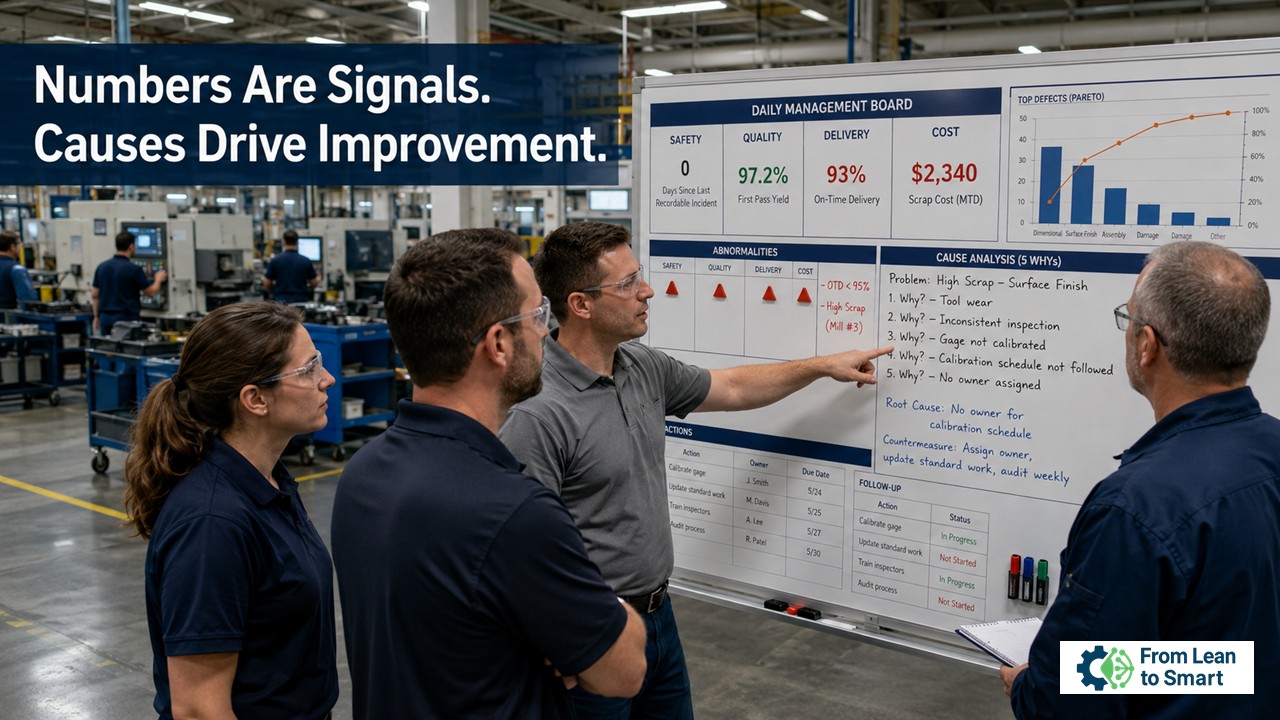
This is one of the most common weaknesses in daily management: the meeting discusses performance, but not the causes behind performance.
A daily management meeting should not be a reporting ritual. It should be a discipline for managing abnormalities, making decisions, escalating issues, and preventing recurrence.
If the meeting only explains yesterday’s numbers, it is both late and weak. The real purpose is to understand what the numbers reveal, determine what must happen next, and remove the conditions that allow problems to repeat.
Numbers Are Signals, Not Causes
A red KPI is not a cause.
Low OEE is not a cause.
High scrap is not a cause.
Missed output is not a cause.
Downtime is not a cause.
A backlog is not a cause.
Absenteeism is not always a cause.
These are signals. They indicate that something has happened, but they do not explain why it happened, what condition allowed it to happen, or what must change in the process.
In many daily meetings, the discussion remains at signal level:
“We lost availability.”
“We had quality issues.”
“Maintenance response was delayed.”
“Material arrived late.”
“The team was short.”
“The machine was unstable.”
“We need to improve.”
The language sounds operational, but it rarely creates operational learning. The meeting ends with reminders, broad commitments, and action lists that are too vague to change the system:
“Follow up with maintenance.”
“Review with quality.”
“Check with logistics.”
“Reinforce the standard.”
“Monitor during the next shift.”
This is not problem-solving. It is administrative movement.
A useful daily management process must move from indicator review to abnormality management. The question is not only whether the KPI is red. The question is what condition created the gap, who owns the response, what decision is required, and how the organization will verify that the condition has changed.
The Meeting Must Expose the Abnormal
A strong daily management meeting starts with a basic but often neglected discipline: separate normal from abnormal.
What was expected to happen?
What actually happened?
Where is the gap?
Is the gap understood?
Is there immediate containment?
Who owns the next step?
Is escalation required?
Has the same abnormality appeared before?
Many organizations skip this discipline. They review too many indicators, too quickly, with too little depth. The meeting becomes a tour of the dashboard rather than a focused discussion about the most important deviations.
The team sees everything and understands little.
Visual management should not exist to decorate a wall with data. It should make the abnormal condition impossible to ignore. If a board or dashboard does not help the team see where action is required, then it is not visual management. It is visual reporting.
The difference matters.
Visual reporting shows information. Visual management triggers decisions.
A board that displays downtime by area but does not distinguish between new, repeated, contained, escalated, and unresolved problems is incomplete. A dashboard that shows scrap evolution but does not connect defects to process conditions, containment actions, and owner accountability is not yet a management system. It is only a display.
The Hidden Problem: Weak Cause Discipline
Daily management becomes powerful when it connects performance gaps with cause thinking.
Not every deviation requires a full A3. Not every issue needs a formal project. But every repeated abnormality deserves a better question.
Why did this happen?
Why did the standard not protect the process?
Why was the issue not detected earlier?
Why did the response fail?
Why did the same loss return?
Why did the countermeasure not sustain?
Without cause discipline, daily meetings become repetitive. The same explanations appear again and again:
“Operator mistake.”
“Machine issue.”
“Supplier problem.”
“Planning change.”
“Maintenance delay.”
“Quality deviation.”
“Lack of training.”
These explanations may contain part of the truth, but they are usually too generic to support improvement.
If “machine issue” appears every week, what failure mode is repeating? Is it wear, contamination, adjustment instability, poor basic conditions, inadequate preventive maintenance, or incorrect operating parameters?
If “operator mistake” appears frequently, what condition made the error likely? Was the standard unclear? Was the workstation poorly designed? Was the detection point too late? Was training assumed but not verified?
If “supplier problem” keeps affecting production, what containment or escalation mechanism is missing? Is the issue being managed through inspection, or has the organization addressed the supplier process, delivery reliability, and quality agreement?
If “planning change” repeatedly disrupts flow, what decision process is unstable? Are priorities changing without clear rules? Is production sequencing disconnected from material availability? Are maintenance windows being sacrificed without understanding the downstream reliability cost?
A daily meeting that does not challenge generic causes will eventually normalize them.
The Danger of Performance Theatre
There is a type of daily meeting that looks disciplined but is not.
People arrive on time. The board is updated. The KPIs are reviewed. The manager asks questions. The team explains deviations. Actions are written down.
From a distance, it looks like Lean management.
But the real behavior tells another story.
People prepare explanations more than they prepare facts. Teams defend their numbers instead of exposing problems. Supervisors avoid uncomfortable causes because they do not want escalation. Maintenance and production negotiate responsibility rather than examine failure conditions. Quality issues are discussed without process evidence. Actions are closed because they were “checked,” not because the abnormal condition changed.
This is performance theatre.
It is dangerous because it gives leaders the impression that the management system is working, while the factory is not actually learning.
A serious daily management system requires both psychological and operational safety. Problems must be visible without turning every deviation into a search for blame. This does not mean avoiding accountability. It means accountability must focus on facts, standards, response discipline, and system improvement rather than on defending yesterday’s result.
The question is not, “Who failed?”
The better question is, “What condition allowed the failure to occur, and what must change so it does not repeat?”
Causes Live at the Gemba
Many daily meetings fail because they try to solve problems from the board.
The board can show where to look.
The gemba shows what is actually happening.
If the top downtime reason is unclear, go to the equipment.
If a quality defect repeats, go to the station and review the standard.
If material feeding causes interruptions, walk the route.
If changeover time is unstable, observe the changeover.
If downtime classification is unreliable, observe how stops are coded under production pressure.
The meeting should not replace gemba. It should direct it.
A strong daily management routine creates a rhythm between the board and the shop floor:
Review the abnormality.
Define immediate containment.
Assign ownership.
Go and see.
Understand the cause.
Take action.
Verify whether the condition changed.
Update the standard if required.
Without that rhythm, daily management becomes detached from operational reality. The team talks about the factory instead of learning from it.
This is especially important in maintenance and reliability. A downtime Pareto may show the most frequent losses, but it will not automatically reveal whether the underlying issue is poor lubrication discipline, unstable operating conditions, spare-part availability, inadequate inspection standards, weak handover between shifts, or delayed decision-making. The data points to the area of concern. The cause must still be understood in the process.
Escalation Is Not Failure
Another common weakness in daily management is poor escalation.
Problems remain at the same level for too long. Supervisors try to solve issues they cannot control. Team leaders absorb recurring abnormalities. Operators adapt to instability. Maintenance priorities are negotiated informally. Quality risks are contained locally. Logistics constraints are explained but not removed.
The meeting records the issue, but the organization does not elevate it to the level where it can be solved.
Escalation should not be seen as failure. Escalation is part of process discipline.
A problem should be solved at the lowest possible level, but it should not be trapped there when the cause sits elsewhere. If the abnormality requires engineering support, supplier intervention, planning decisions, maintenance resources, quality authorization, or management alignment, then escalation is the responsible behavior.
For escalation to work, the daily management system must define clear rules:
What gets escalated?
When does it get escalated?
To whom is it escalated?
With what facts or evidence?
What decision is expected?
How will follow-up be verified?
Without these rules, problems remain visible but unresolved. That is one of the most frustrating forms of waste: the organization can see the issue, but the management system is not strong enough to remove it.
Leadership Determines the Quality of the Conversation
Leaders shape the quality of daily management by the questions they ask.
If leaders only ask, “Did we hit the target?”, people will focus on explaining the result.
If leaders ask, “What caused the gap?”, people will bring more analysis.
If leaders ask, “What did we verify at the gemba?”, people will go and see.
If leaders ask, “What condition must change so this does not repeat?”, people will think beyond containment.
If leaders ask, “What decision is needed today?”, the meeting becomes more than a review.
If leaders ask, “What support do you need?”, escalation becomes normal.
If leaders punish bad news, the system will hide problems.
Daily management is not improved mainly by changing the board design. It is improved by changing leadership behavior, decision discipline, and follow-through.
The board is only a tool. The meeting is only a routine. The real management system is the quality of the conversation, the clarity of ownership, the speed of decisions, and the verification of results.
Digital Daily Management: Useful, but Not Sufficient
Many factories are moving from physical boards to digital dashboards, tiered meeting platforms, MES screens, automated alerts, and real-time performance visibility.
These tools can help. They can reduce manual effort, improve data availability, connect shifts, accelerate escalation, and make trends easier to analyze.
But digital daily management can also make the same weak process faster and more attractive.
A dashboard that shows losses without cause discipline is still weak.
An alert without ownership is still noise.
A digital action list without verification is still administration.
A real-time KPI without response logic is still reporting.
A meeting with more data but no better questions is still theatre.
The quality of digital daily management depends on the quality of the management system behind it.
MES data is useful only if reason codes are meaningful, consistently applied, and reviewed. Automated alerts are useful only if response ownership is clear. Digital action tracking is useful only if closure means that the condition changed, not merely that someone updated a status field.
Technology should strengthen operational discipline. It should not replace it.
The value of digital daily management is not that leaders can see more. The value is that teams can decide better, respond faster, escalate with facts, and learn more consistently.
From Reporting Rhythm to Learning Rhythm
The real maturity shift is moving from a reporting rhythm to a learning rhythm.
A reporting rhythm asks:
What happened yesterday?
What is red?
Who will follow up?
When will the action be closed?
A learning rhythm asks:
What did we expect?
What actually happened?
What condition created the gap?
What did we verify at the gemba?
What decision is required today?
What support is needed?
What will prevent recurrence?
How will we know that the countermeasure worked?
This shift changes the purpose of the meeting.
The objective is no longer to survive the review. The objective is to improve the operating system.
That is what daily management should be: not a place where numbers are announced, explanations are defended, and actions accumulate, but a disciplined routine where operational truth becomes visible, causes are understood, decisions are made, and learning becomes part of daily work.
A factory does not improve because it reviews more indicators. It improves when its management system helps people see abnormalities earlier, understand causes more clearly, escalate issues at the right level, and change the conditions that produce recurring losses.
Numbers matter. But numbers alone do not manage the factory.
The real test of a daily management meeting is not whether the board was updated. It is whether the meeting changed a decision, clarified ownership, improved a standard, removed an obstacle, or prevented a problem from returning.
#LeanManufacturing #OperationalExcellence #DailyManagement #VisualManagement #Gemba #ContinuousImprovement #ShopfloorManagement #ProblemSolving #ProcessDiscipline #ManufacturingExcellence #OperationalLeadership #SmartFactory #MES #Reliability