
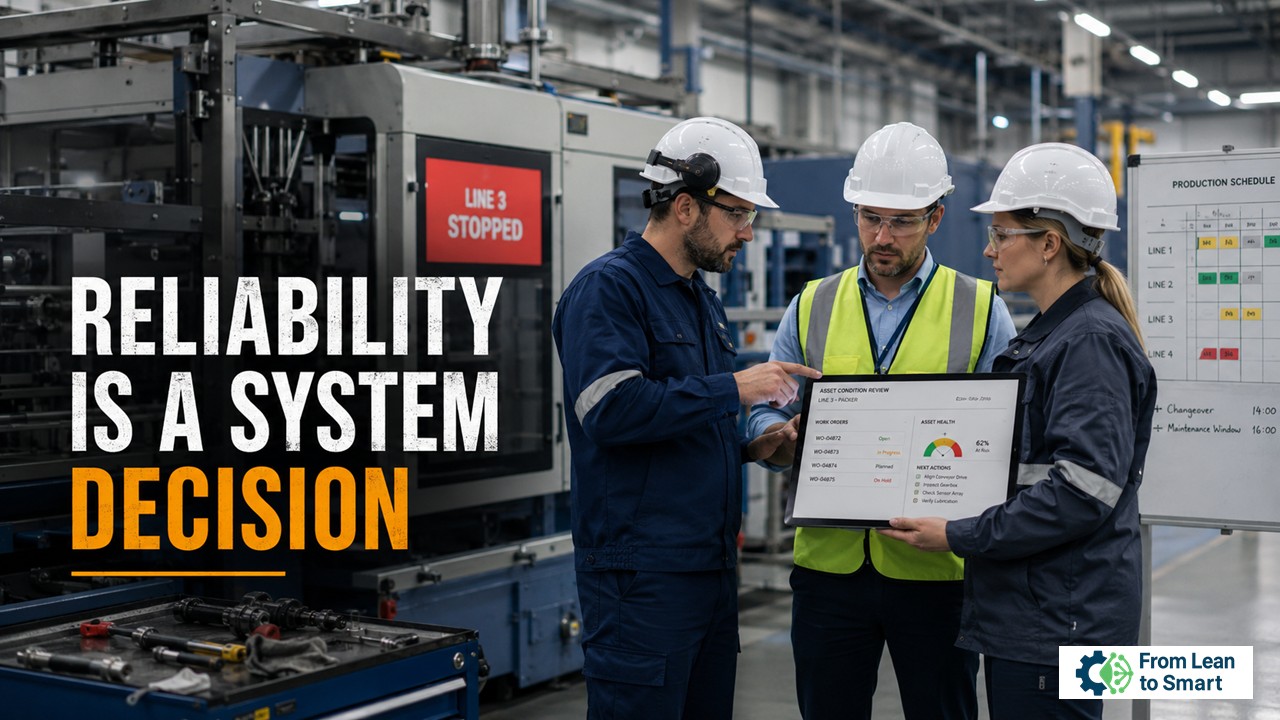
In many factories, reliability is still treated as something that belongs primarily to maintenance.
When an asset fails, maintenance is called.
When breakdowns increase, maintenance is challenged.
When availability drops, maintenance is asked to explain.
When the same failure returns, maintenance is expected to “fix it properly this time.”
There is some truth in that expectation. Maintenance owns essential technical disciplines: inspection, lubrication, troubleshooting, preventive maintenance, condition monitoring, planning, work execution, failure analysis, and CMMS/EAM discipline.
But reliability is not created by maintenance alone.
Reliability is created — or destroyed — by the way the whole industrial organization makes decisions about equipment, production priorities, engineering changes, quality standards, spare parts, operating limits, maintenance windows, and risk.
That is why reliability should not be understood as a technical department.
It is an organizational capability.
The Failure Appears on the Asset, but the Causes Often Live Elsewhere
A breakdown may appear as a maintenance event, but its causes are often distributed across the factory.
A bearing fails prematurely. Maintenance replaces it. The line starts again. The work order is closed.
From a narrow technical perspective, the job is complete.
But the real story may be different.
The machine may have been running above its original design envelope because production demand increased. Operators may have learned to bypass small abnormalities because stopping the line is culturally discouraged. Lubrication standards may exist, but the access point is difficult and the task is frequently delayed. Spare parts may be available, but not always with the required technical quality. Engineering may have modified the process months earlier without updating the maintenance strategy. The CMMS history may say “bearing replaced,” but not explain why the bearing failed.
The failure occurred on the asset.
The reliability problem belongs to the system.
This is where many organizations lose years. They improve technical response without changing the decisions that create recurrence. They reduce mean time to repair, but not the conditions that make failure probable. They celebrate firefighting, but leave untouched the organizational routines that keep producing fires.
Maintenance can repair failure. The organization must remove fragility.
Maintenance Cannot Compensate Forever for Weak Organizational Discipline
Good maintenance teams can keep a factory alive under pressure. They recover equipment with limited time, incomplete information, imperfect spare parts, and production demanding restart. Experienced technicians understand vibration, noise, temperature, sequence logic, contamination, wear patterns, and the small operational details that never appear in design documentation.
But even the best maintenance team cannot compensate indefinitely for weak organizational discipline.
Reliability suffers when production plans leave no realistic space for preventive work.
It suffers when engineering changes equipment without updating maintenance requirements.
It suffers when procurement optimizes purchase price while increasing technical risk.
It suffers when quality accepts unstable process conditions because output pressure is higher than process discipline.
It suffers when finance sees maintenance only as cost, rather than as protection of asset value.
It suffers when leadership asks for reliability but rewards short-term recovery more visibly than long-term stability.
This is not about blaming other functions.
It is about recognizing that reliability is cross-functional by nature.
Maintenance may own the work order.
The organization owns the operating context.
The Dangerous Comfort of Having a Reliability Department
Creating a reliability engineering role or department can be highly valuable. It brings focus, method, and structure. It can strengthen RCA, asset criticality, maintenance strategy, predictive technologies, failure mode analysis, bad actor management, and lifecycle decision-making.
But there is also a risk.
The moment reliability becomes “their job,” the rest of the organization may disengage.
Production continues to treat maintenance windows as negotiable. Engineering continues to hand over assets without sufficient maintainability discipline. Planning protects volume but not asset health. Procurement manages spares as inventory cost instead of risk exposure. Maintenance closes work orders without capturing enough failure context.
Then reliability becomes a reporting function rather than an operating capability.
The department analyzes.
The system continues to behave in the same way.
A reliability engineer can identify a chronic failure pattern. But if the factory cannot stop the equipment, change the standard, adjust the operating condition, improve the spare-part strategy, or challenge the production plan, the analysis becomes another document.
Insight without decision authority does not improve reliability.
Reliability Lives in Trade-Offs
Factories are full of trade-offs.
Run now or stop for inspection.
Use the available spare or wait for the correct one.
Postpone preventive work or protect the maintenance window.
Accept a temporary repair or remove the root cause.
Push the asset harder or protect long-term capability.
Invest in redesign or continue absorbing failures.
These are not only technical decisions. They are operational decisions made under uncertainty.
That is why reliability maturity depends heavily on governance.
Not governance as bureaucracy, but governance as clarity: who decides, based on what information, with which risk visibility, and with what accountability.
A mature organization does not eliminate trade-offs. It makes them visible, explicit, and traceable.
It knows which assets are truly critical. It understands what risk is being accepted when work is deferred. It protects planned maintenance when the consequence of skipping it is high. It uses CMMS/EAM data not only to record activity, but to learn from repeated decisions. It connects production priorities with asset condition. It treats temporary repairs as open risk, not closed success.
Reliability improves when the organization becomes better at deciding.
From Technical Excellence to Organizational Learning
Technical competence remains essential. Reliability should never be reduced to a cultural slogan while ignoring fundamentals such as lubrication, alignment, contamination control, precision maintenance, inspection quality, spare parts, planning discipline, and standard work.
But technical excellence only scales when the organization learns.
A repeated failure should not only generate another repair. It should trigger a disciplined review of the operating condition, maintenance strategy, process standard, equipment design, spare-part policy, planning horizon, and decision pattern that allowed recurrence.
A maintenance backlog should not only be measured by the number of open orders. It should be interpreted as accumulated operational risk.
A condition monitoring alert should not only be evaluated technically. It should be connected to production plans, maintenance windows, spare-part availability, asset criticality, and risk acceptance.
A high availability number should not automatically be celebrated. It may be hiding postponed maintenance, temporary repairs, quality losses, accelerated degradation, or excessive dependence on heroic interventions.
The question is not whether maintenance is busy.
The question is whether the organization is learning from what maintenance sees.
The Real Role of Maintenance in a Reliable Organization
In a mature reliability system, maintenance is not reduced to execution.
Maintenance becomes a source of operational intelligence.
Technicians bring contextual knowledge from the asset. Planners translate risk into executable work. Reliability engineers identify patterns and failure mechanisms. Supervisors balance urgency with discipline. Maintenance managers connect technical reality with business consequences.
But they cannot do this in isolation.
Reliability requires production to respect asset limits. It requires engineering to design and modify equipment with maintainability in mind. It requires procurement to understand technical risk, not only purchase price. It requires finance to evaluate lifecycle cost, not only immediate expense. It requires leadership to protect improvement time, not only demand results.
The best reliability organizations do not ask maintenance to “own reliability” alone.
They ask maintenance to lead the technical discipline while the business owns the conditions that make reliability possible.
That difference matters.
One model creates dependency on heroes.
The other creates organizational capability.
Reliability Is a Management System, Not a Slogan
Many plants say they want reliability. Fewer are willing to manage the consequences of that statement.
Reliability requires uncomfortable discipline.
It means saying no to operating equipment in unsafe, unstable, or clearly degraded conditions. It means protecting maintenance windows when production pressure is high. It means investing in root cause removal instead of celebrating fast recovery. It means improving master data before expecting advanced analytics to deliver useful insight. It means treating asset criticality as a decision model, not a spreadsheet exercise. It means learning from failures without turning every review into blame.
It also means accepting that reliability will never be achieved by dashboards alone.
A dashboard can show failures.
A CMMS can record work.
A predictive model can detect risk.
A reliability engineer can propose actions.
But the organization must decide, prioritize, execute, and learn.
That is where reliability becomes real.
The Practical Shift
The shift is simple to describe and difficult to practice:
Stop asking only:
“Why did maintenance not prevent this failure?”
Start asking:
“Which organizational decisions made this failure likely, repeated, or expensive?”
That question changes the conversation.
It moves reliability from the workshop to the management system. It connects maintenance with production, engineering, quality, planning, procurement, and finance. It makes failure analysis more honest. It turns asset data into operational learning. It protects people from endless firefighting and gives the business a better way to manage risk.
A useful reliability review should therefore examine more than the last repair. It should look at deferred maintenance, temporary repairs, spare-part substitutions, operating condition changes, engineering modifications, and repeated deviations from standard work. These are not administrative details. They are risk decisions.
In many factories, CMMS/EAM data is rich in activity but poor in learning. The opportunity is to capture better failure context, connect it with asset criticality, and use it to influence planning, prioritization, and long-term reliability decisions.
Reliability is not achieved when maintenance works harder.
Reliability is achieved when the organization makes better decisions about its assets, every day.
The final test of a reliability culture is not how fast the plant reacts to failure. It is whether the organization has the discipline to see failure as evidence of how it decides, prioritizes, executes, and learns.
#OperationalExcellence #IndustrialMaintenance #Reliability #AssetManagement #ManufacturingExcellence #MaintenanceStrategy #CMMS #SmartFactory #ContinuousImprovement #OperationalDiscipline