From advanced analytics to better operational decisions
Industrial companies are investing heavily in advanced software, analytics and AI to improve manufacturing performance.
The ambition is clear.
Understand what is happening across production processes.
Detect where efficiency is lost.
Identify the constraints that matter.
Act faster on the opportunities that can improve performance.
That ambition is necessary.
Factories are under pressure to become more efficient, resilient and sustainable. Production teams need better visibility. Leaders need faster decisions. Operations need stronger execution. And organizations need to know not only what happened yesterday, but where the next constraint, deviation or loss is likely to appear.
But there is one point that should not be underestimated:
AI-powered manufacturing software does not create value because it is advanced.
It creates value when it changes how people manage, decide and improve operations on the shopfloor.
A platform can reveal losses.
A model can detect patterns.
A dashboard can highlight opportunities.
A rollout can put the software in front of users.
But measurable industrial impact appears only when those insights are embedded into daily routines, production decisions, Lean problem solving and cross-functional execution.
This is where many digital manufacturing initiatives succeed or fail.
Not in the demo.
Not in the pilot.
Not in the dashboard.
But in the transition from software capability to operational habit.
The Real Challenge: From Pilot to Operating Rhythm
Many manufacturing software initiatives start with energy.
There is a clear pain point.
A pilot is launched.
Data is connected.
Dashboards are created.
Early findings look promising.
Teams see losses that were previously hidden.
Management becomes interested.
Then the difficult part begins.
Who owns the insight?
Who acts on it?
Which meeting reviews it?
Which decision changes because of it?
How is impact measured?
How does the software become part of the normal way the factory runs?
This is the gap between pilot success and operational adoption.
In manufacturing, adoption does not happen because a tool is available.
Adoption happens when the tool helps people solve problems that already matter to them:
Schedule adherence.
Material availability.
Changeovers.
Downtime.
Scrap.
Rework.
Throughput.
Energy consumption.
Labor productivity.
OEE losses.
Delivery reliability.
The key question is not:
Can the software show the opportunity?
The stronger question is:
Can the organization turn that opportunity into better execution?
That requires more than analytics.
It requires Manufacturing Excellence.
Manufacturing Data Is Not the Same as Manufacturing Reality
Industrial companies already have many systems.
ERP contains orders, demand, materials, purchasing, inventory and financial transactions.
MES captures execution, batches, production quantities, downtime and quality checks.
CMMS and EAM systems store maintenance work orders, asset history and preventive maintenance plans.
QMS platforms manage deviations, non-conformities, corrective actions and quality records.
Planning tools define sequences, capacity assumptions and production priorities.
On paper, the data is there.
In reality, the factory often runs across systems, spreadsheets, whiteboards, shift reports, informal routines and decisions made under pressure.
That matters.
Because AI and analytics can only create value if operational context is understood.
A timestamp may show a delay.
The shopfloor explains the constraint.
A dashboard may show a loss.
The team explains the mechanism.
A model may detect a pattern.
Operational knowledge determines whether it is actionable.
A workflow may show compliance.
Gemba may show that the process is being bypassed to keep production running.
This is why AI-powered manufacturing software must be implemented with a deep understanding of production processes, Lean principles, stakeholder behavior and frontline routines.
Without that connection, companies risk creating technically correct insights that do not survive contact with daily operations.
Insight Is Only Valuable When It Changes a Decision
Manufacturing software often promises visibility.
Visibility is useful.
But visibility alone is not improvement.
A dashboard does not improve flow by itself.
A prediction does not remove a bottleneck by itself.
An alert does not solve a quality problem by itself.
A model does not create accountability by itself.
The real value appears when insight changes a decision.
What should we prioritize today?
Which loss deserves structured problem solving?
Which asset needs intervention before failure?
Which production sequence creates unnecessary instability?
Which material constraint will affect execution?
Which recurring defect needs escalation?
Which standard must be reviewed?
Which action owner must be assigned?
This is the shift from analytics to management.
The objective is not to generate more information.
The objective is to improve the decision flow of the factory.
Use Case 1: Production Flow and Schedule Adherence
One of the strongest areas for AI-powered manufacturing software is the gap between the production plan and real execution.
Many factories already have ERP, MES, planning tools and daily production meetings.
Still, the plan often breaks quickly.
The reasons are familiar:
Materials are not available when needed.
Quality blocks delay release.
Changeovers take longer than expected.
Maintenance interventions interrupt the sequence.
Capacity assumptions are too optimistic.
Commercial priorities change.
Operators and supervisors adjust the plan to keep the line running.
In this environment, schedule adherence is not only a planning KPI.
It is a mirror of the factory operating system.
Advanced software can help reveal where the plan starts to deviate from reality, which losses repeat, which constraints create the largest impact and where hidden inefficiencies accumulate.
But the value is not only in detecting deviation.
The value is in helping teams understand why the deviation happens and what decision should change.
Should planning rules be adjusted?
Should material preparation be improved?
Should changeover standards be reviewed?
Should maintenance windows be better synchronized?
Should sequencing logic consider quality or cleaning constraints?
Should the daily meeting focus on different leading indicators?
Should escalation happen earlier?
This is where software must connect with Lean Manufacturing:
Flow.
Bottlenecks.
Standard work.
Visual management.
Daily management.
SMED.
Problem solving.
Escalation routines.
The goal is not simply a better dashboard.
The goal is a more stable production system.
Use Case 2: OEE Losses, Downtime and Asset-Related Constraints
OEE is widely used in manufacturing.
But many organizations still struggle to convert OEE reporting into performance improvement.
The problem is that OEE often becomes a reporting exercise instead of a decision system.
Availability losses may come from unplanned downtime, minor stops, slow changeovers or waiting for materials.
Performance losses may be linked to unstable processes, microstops, operator workarounds, product mix, machine settings or process conditions.
Quality losses may come from scrap, rework, start-up losses, material variation or poor process capability.
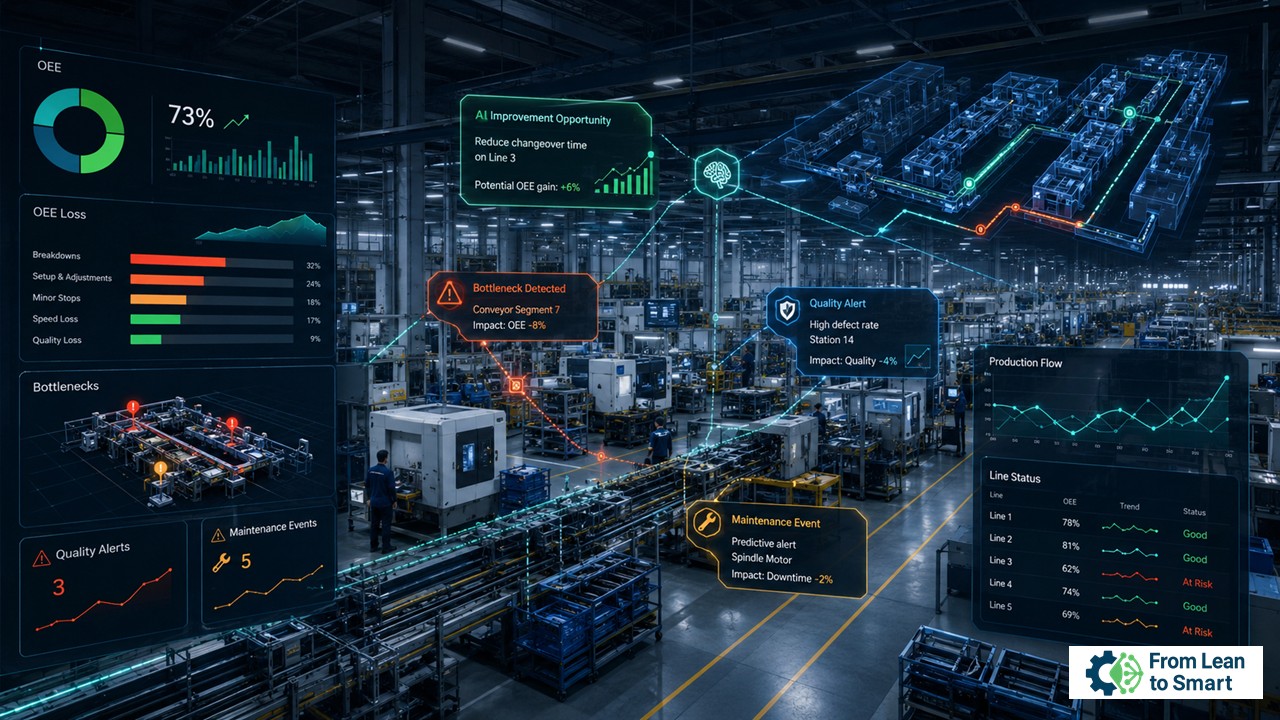
AI-powered manufacturing software can help identify patterns across lines, shifts, products, machines and time windows.
It can show where losses repeat, which constraints matter most and which improvement opportunities have the highest operational relevance.
But again, the critical part is interpretation.
A machine with high downtime is not automatically the right improvement priority.
A recurring stop is not always a maintenance problem.
A performance loss is not always caused by the operator.
A quality loss may be connected to material, settings, maintenance condition, changeover discipline or process capability.
To create value, analytics must connect with asset criticality, failure modes, maintenance workflows, production routines and root cause discipline.
This is where Manufacturing Excellence requires cross-functional work between production, maintenance, quality, planning and continuous improvement.
The real question is not only:
Where are we losing OEE?
The better question is:
Which losses should we attack first, with which ownership, through which routine, and with what expected impact?
That is the difference between measuring losses and improving performance.
Use Case 3: Quality, Scrap and Recurring Deviations
Quality losses are another area where industrial software can create significant value.
Factories often track scrap, rework, non-conformities, deviations, customer complaints and corrective actions.
Yet recurring issues continue to appear.
This means the challenge is not only data availability.
The challenge is organizational learning.
AI and analytics can help detect patterns in defects, products, lines, shifts, suppliers, process parameters or operating conditions.
They can help teams identify where quality losses are concentrated and which variables may be associated with recurrence.
But quality improvement cannot rely only on correlation.
A defect pattern must be connected to process knowledge, root cause analysis, control plans, FMEA, standards, training, maintenance condition and Gemba validation.
A closed corrective action is not always a solved problem.
A fast closure is not always an effective closure.
A recurring defect is a signal that the operating system has not learned enough.
The value of software in quality is not only to show where scrap happens.
The value is to help teams reduce recurrence by improving how the organization detects, investigates, standardizes and sustains corrective action.
That requires a connection between digital insight and structured problem solving:
8D.
A3.
DMAIC.
Control plans.
Layered process audits.
Daily quality routines.
Standard work confirmation.
In other words, quality analytics should not become another reporting layer.
It should strengthen the learning loop of the factory.
From Dashboards to Closed-Loop Improvement
One of the biggest risks in digital manufacturing is stopping at visibility.
A factory may have excellent dashboards and still weak execution.
The dashboard shows the deviation.
But nobody owns the next step.
The model detects the pattern.
But the team does not validate it at Gemba.
The report shows the recurring loss.
But the daily meeting does not convert it into action.
The system identifies the opportunity.
But there is no closed-loop mechanism to sustain improvement.
This is where digital initiatives need operating discipline.
Every relevant insight should answer five practical questions:
What problem does this insight reveal?
Who owns the action?
Which routine will review progress?
How will impact be measured?
How will the learning be standardized?
Without that loop, AI becomes another layer of visibility.
With that loop, AI becomes part of the management system.
What Customer Rollouts Really Require
Rolling out AI-powered manufacturing software is not only a technical implementation.
It is a customer transformation process.
It requires understanding the customer’s production system, identifying pain points that matter, building trust with stakeholders, demonstrating value early and making the solution part of day-to-day operations.
This is especially important when moving from pilot to long-term adoption.
A successful rollout must answer practical questions:
What operational problem are we solving?
Who owns the use case?
Which KPI will show impact?
Which users need to change their routine?
How will insights be reviewed?
What decisions will the software support?
How will feedback from the factory improve the product?
How do we avoid creating another dashboard that nobody uses?
The best software companies understand that customer value is created at the intersection of product capability and operational adoption.
The product must be strong.
But the use case must be real.
The stakeholders must trust it.
The routines must absorb it.
The impact must be visible.
This is why roles that combine manufacturing expertise, Lean thinking, customer ownership and software adoption are so important.
They translate between worlds:
Between product teams and plant teams.
Between data and decision-making.
Between pilots and rollouts.
Between software functionality and measurable operational impact.
Between what the model can show and what the factory can actually change.
That translation capability is often underestimated.
But it is one of the main reasons why some digital manufacturing initiatives scale while others remain as isolated pilots.
Data Quality Is Also an Operational Issue
AI depends on data.
But in manufacturing, data quality is rarely only a technical problem.
It is usually an operational problem.
Downtime codes may be too generic.
Scrap reasons may be selected inconsistently.
Work orders may lack failure context.
Manual entries may be delayed.
Shift reports may describe symptoms, not causes.
Master data may not reflect the real asset structure.
Different sites may define the same KPI differently.
When this happens, analytics can still produce outputs.
But the outputs may not be trusted.
And when shopfloor teams do not trust the insight, adoption weakens.
This is why data governance must be connected to operations.
Not as bureaucracy.
But as a way to make decisions more reliable.
Better data capture should make life easier for the factory, not harder.
The objective is not perfect data.
The objective is decision-grade data.
Data good enough, consistent enough and contextual enough to support better operational decisions.
AI Should Strengthen Lean, Not Replace It
The next generation of manufacturing software will not win only because it has better algorithms.
It will win because it helps factories manage better.
That means helping teams make faster decisions, reduce losses, stabilize flow, improve quality, use resources more efficiently and build more resilient operations.
AI can reveal patterns that humans may miss.
But Manufacturing Excellence is still built through:
Ownership.
Standards.
Routines.
Problem solving.
Leadership behavior.
Gemba validation.
Cross-functional execution.
Continuous improvement discipline.
The future is not AI instead of Lean.
The future is AI strengthening Lean execution.
Not dashboards instead of Gemba.
Dashboards connected to Gemba.
Not pilots that impress.
Rollouts that sustain.
Not isolated insights.
Operational habits that improve performance every day.
Final Thought
AI-powered manufacturing software creates real industrial value when it becomes part of how the factory works.
Not when it only shows more data.
Not when it only creates more dashboards.
Not when it only proves that algorithms can detect patterns.
Its value appears when it helps people make better decisions, act earlier, solve the right problems and sustain improvements across the shopfloor.
That is where digital manufacturing becomes more than technology.
It becomes operational capability.
And that capability is built where manufacturing performance is won or lost every day:
On the shopfloor.
Where decisions are made.
Where losses are recovered.
Where standards are followed or broken.
Where problems repeat or get solved.
Where improvement becomes visible.
That is where AI-powered manufacturing software creates real industrial value.
#AI #ManufacturingSoftware #SmartFactory #Industry40 #ManufacturingExcellence #OperationalExcellence #LeanManufacturing #ContinuousImprovement #ProcessMining #IndustrialAI #DigitalTransformation #ShopfloorManagement #OEE #QualityManagement #ProductionPlanning #DataDrivenOperations #ManufacturingLeadership