Factories rarely underperform because a system lacks another dashboard.
More often, they underperform because the organization cannot connect what happened on the shopfloor with who was involved, what material was used, which method was followed, and what machine condition existed at that moment.
This is why the 4M view remains highly relevant in digital operations.
In many MES/MOM discussions, the conversation starts with transactions, dashboards, OEE, traceability, system integration or real-time visibility. These elements matter. But before any digital system can support better operational decisions, it must represent the factory’s execution context with sufficient discipline.
And in manufacturing, execution context is rarely one-dimensional.
A downtime event is not only a downtime event.
A quality defect is not only a defect.
A production delay is not only a planning issue.
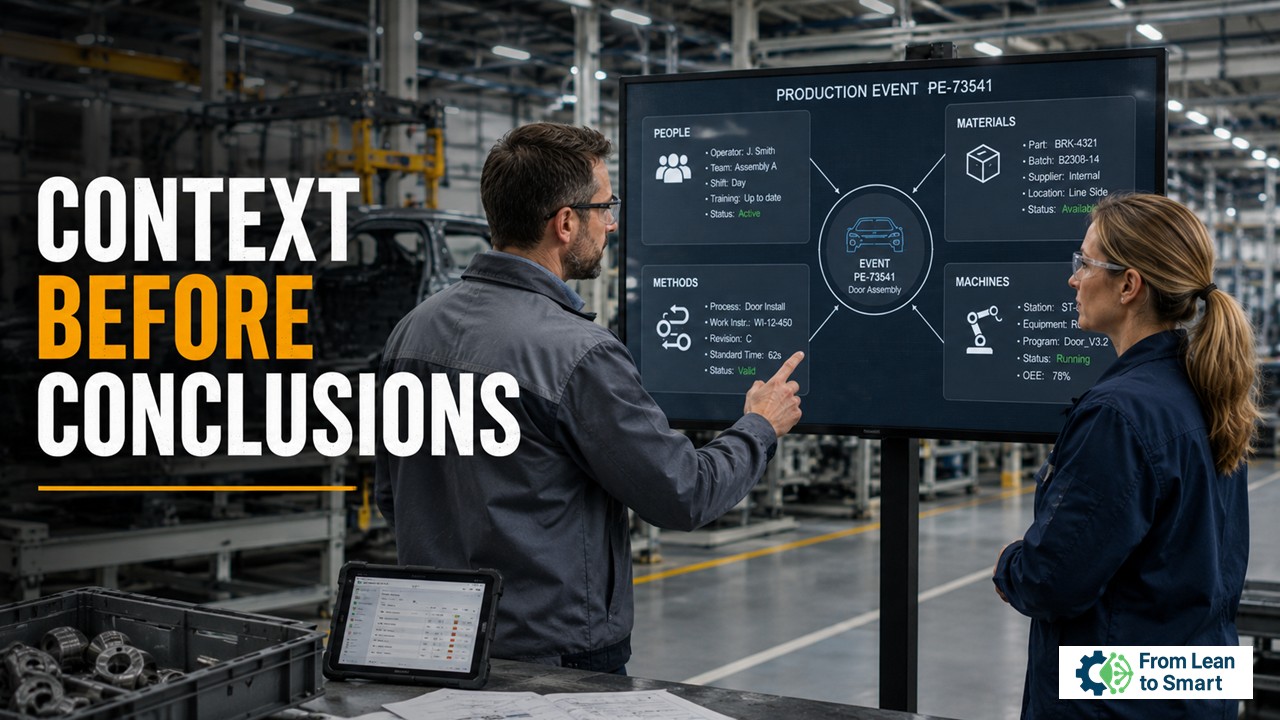
Each event exists inside a specific combination of people, materials, methods and machines.
When MES/MOM does not capture that combination, the factory may become more visible, but not necessarily more intelligent.
Visibility without context is a dangerous comfort.
A plant may know that Line 3 lost 42 minutes during a shift. It may know the reason code. It may even display a Pareto chart. But if the organization cannot connect that loss to operator qualification, material batch, setup method, equipment condition, recipe version, maintenance history or parameter deviation, the improvement discussion remains superficial.
The factory sees the number, but not the operating system behind the number.
That is where the 4M view becomes powerful. It forces digital operations to stop treating production events as isolated records and start treating them as operational evidence.
People: Roles, Capability and Decision Responsibility
In the traditional 4M model, “Man” refers to the human dimension of the process. In modern operations, it is better understood as people, skills, roles, authorization, workload and decision responsibility.
This is not about assigning blame to operators. Serious factories do not use digital systems to find someone to blame. They use them to understand whether the right process conditions were in place.
Was the operator qualified for that product variant?
Was a temporary worker assigned to a complex operation without sufficient support?
Was the supervisor managing too many exceptions at the same time?
Was the maintenance technician working with the correct procedure, spare part information and equipment history?
MES/MOM should not reduce people to badge IDs. It should help the organization understand the relationship between human capability and process performance.
Respect for people also means designing systems that make abnormalities visible without converting every deviation into personal fault. A mature digital operation distinguishes between human error, weak standards, poor training, unclear escalation, unstable materials and inadequate equipment conditions.
That distinction is essential for serious improvement.
Materials: Genealogy, Variability and Process Consequences
Materials are often underestimated in digital operations.
A plant may have acceptable production reporting and still have poor material context. It may know that a defect occurred, but not easily connect it to a supplier lot, internal batch, storage condition, substitution, expiration rule, mixing sequence or handling deviation.
This matters because many industrial problems are not created at the point where they are detected.
A defect found at final inspection may have started with incoming material variation. A machine adjustment may compensate for material behaviour until the process can no longer absorb the variation. A change in packaging, humidity, viscosity, tolerance or surface condition may create instability that operators experience simply as “the machine is difficult today”.
Without reliable material genealogy, the factory debates opinions.
With material context, it can begin to learn from evidence.
The material dimension is therefore not only a traceability requirement. It is a foundation for containment, root cause analysis, supplier feedback, process control and risk-based decision-making.
Methods: Standards, Recipes and the Real Way of Working
Methods are where many MES/MOM implementations become uncomfortable.
It is relatively easy to digitize a work instruction. It is much harder to ensure that the instruction reflects the real process, is version-controlled, is usable at the shopfloor, and is connected to execution evidence.
The method dimension includes standard work, routing, recipes, parameters, quality checks, inspection plans, setup procedures, changeover logic, escalation rules and approval points.
When methods are weak, MES can accidentally industrialize confusion.
A digital work instruction that nobody trusts is not a standard.
A recipe that can be bypassed without governance is not control.
A checklist completed after the fact is not process discipline.
The method dimension asks a demanding question:
When we say that the process was executed correctly, what evidence do we actually have?
This is where digital operations must move beyond document management. The goal is not only to store standards, but to connect standards with execution, deviations, approvals and learning.
Machines: Equipment State, Capability and Asset Behaviour
Machines are not only physical assets. In digital operations, they are sources of state, constraints, variation and risk.
Was the equipment running within normal parameters?
Was there a recent maintenance intervention?
Was a sensor drifting?
Was the tool close to end of life?
Was the machine operating in manual mode?
Was cycle time variation increasing before the stoppage?
This is where MES/MOM must connect with SCADA, PLCs, historians, CMMS/EAM and, in some environments, condition monitoring systems.
But connectivity alone is not enough.
A signal is not intelligence until it is placed in operational context. Machine data becomes valuable when it helps explain production performance, quality behaviour, maintenance needs and operational decisions.
A machine alarm, a parameter deviation or a maintenance intervention has limited value as an isolated record. Its value increases when it can be related to product, batch, recipe, operator action, inspection result, downtime, scrap, rework or escalation.
That is the difference between collecting equipment data and understanding asset behaviour.
Where the 4M View Fits in MES/MOM Architecture
The 4M view sits at the centre of MOM because it connects execution with context.
ERP may define demand, orders, materials and financial logic.
SCADA and PLCs may provide equipment signals.
CMMS/EAM may manage asset maintenance.
QMS or LIMS may manage quality rules, inspections and laboratory results.
MES/MOM must connect these realities into a coherent execution model.
This is why the production model is not merely an IT structure. It is the digital operating map of the factory.
A mature MOM architecture must understand:
- who is executing, supervising or approving the work;
- what material is being consumed, transformed or produced;
- which method, recipe, standard or inspection rule applies;
- which equipment is being used, and under what condition.
Without this structure, the factory receives fragmented data. With it, the factory can build traceability, abnormality management, OEE loss analysis, quality containment, maintenance integration and continuous improvement on a stronger operational foundation.
A Practical Example: A Defect After Changeover
Imagine a repeated defect appearing after a changeover.
A weak digital operation records scrap quantity, shift, line and perhaps a generic reason code: “process defect”.
A stronger 4M view connects the event differently.
The people dimension shows that the changeover was performed by a team that had not executed this variant for several weeks.
The material dimension shows that a new supplier batch was introduced during the same production window.
The method dimension shows that the setup instruction had been updated, but the printed version near the line was still obsolete.
The machine dimension shows that one adjustment parameter was drifting and had already been manually corrected several times.
Now the improvement conversation changes.
The question is no longer: “Who made the defect?”
The question becomes: “Which combination of conditions allowed the defect to appear?”
That is a more useful and more mature discussion.
It may lead to better training, material confirmation rules, digital version control, recipe locking, first-off approval, maintenance inspection, parameter monitoring or clearer escalation criteria.
The point is not to collect more data. The point is to create better operational learning.
Typical Mistakes When Applying the 4M View
The first mistake is treating 4M as a form instead of a decision model. If operators enter people, material, method and machine information but nobody uses it to improve decisions, the system becomes an administrative burden.
The second mistake is assuming that all 4M data must be captured automatically. Some data can come from systems. Some requires human confirmation. Some requires structured exception reporting. The design must respect operational reality.
The third mistake is copying master data from ERP without validating it at the gemba. ERP structures are essential, but they do not always reflect how the line actually runs, how equipment is grouped, how changeovers happen or how operators identify problems.
The fourth mistake is using 4M only for traceability after a problem. The real value appears earlier: preventing errors, detecting abnormal conditions, guiding execution and improving the quality of daily decisions.
Before Implementing 4M-Based Digital Operations
Before implementing this capability, the factory should answer several practical questions.
Does the production model reflect real shopfloor execution, or only system configuration?
Are roles, skills and authorizations defined well enough to support execution control without creating unnecessary bureaucracy?
Is material genealogy reliable enough to support containment and root cause analysis?
Are methods, recipes and work instructions version-controlled and connected to actual execution evidence?
Is equipment data meaningful, or merely available?
Do supervisors, engineers, quality teams and maintenance teams know how they will use 4M context in daily management, quality review, maintenance coordination and continuous improvement?
These questions matter because MES/MOM does not create value by adding another layer of digital recording. It creates value when information changes the quality, speed and discipline of operational decisions.
Final Reflection
The 4M view is not a nostalgic manufacturing concept. It is one of the most practical foundations for digital operational excellence.
It reminds us that factory performance is systemic. People, materials, methods and machines interact continuously. Losses, defects and instability are rarely the result of one isolated factor; they usually emerge from the interaction of several conditions.
A reason code may tell the organization where to start. The 4M context helps it understand what really interacted to create the loss.
That distinction is critical.
A connected factory is not intelligent because everything is connected. It becomes intelligent when those connections help people understand reality, act with discipline, prevent recurrence and improve the system.
#OperationalExcellence #SmartFactory #MES #IndustrialMaintenance #ManufacturingExcellence #AssetManagement #Reliability #ContinuousImprovement #BPM #ProcessMining