
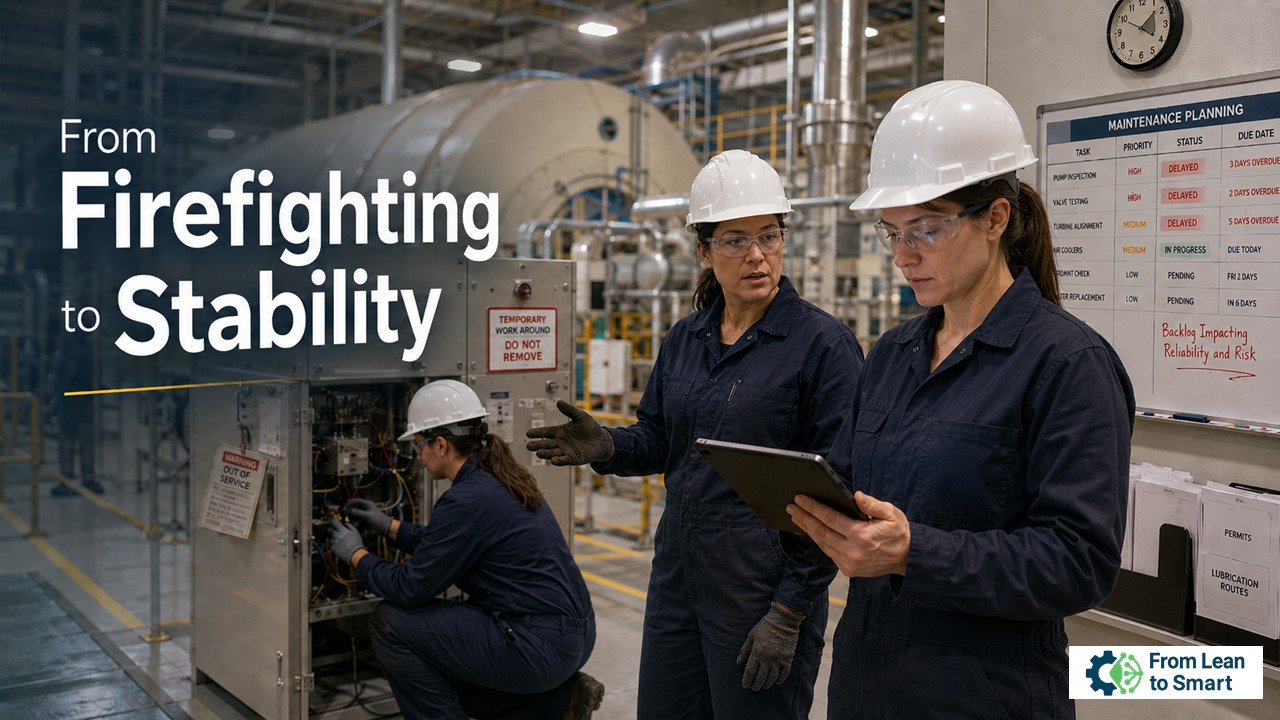
And why faster reaction is not the same as maintenance maturity
Every maintenance organization says it wants to reduce firefighting.
Very few actually change the conditions that create it.
In many factories, firefighting is treated as a maintenance behavior problem.
Technicians react too much.
Supervisors escalate too late.
Planners cannot protect the schedule.
Preventive work gets interrupted.
Root cause actions remain open.
But firefighting is rarely caused by maintenance alone.
Firefighting becomes culture when the organization repeatedly rewards recovery more than prevention.
That is the real issue.
Not the emergency itself.
The pattern behind the emergency.
Emergency Response Is Necessary. Dependence on It Is Not.
In industrial operations, emergencies will always exist.
Machines fail.
Sensors drift.
Components wear.
Operators detect abnormal conditions.
Quality problems appear.
Production demand changes.
Unexpected issues happen even in mature plants.
A good maintenance organization must be able to respond quickly when needed.
There is nothing wrong with strong emergency response.
The problem begins when emergency response becomes the normal way of operating.
When the plant depends on urgency to keep running.
When every day requires heroics.
When planned work is always negotiable, but breakdowns are never questioned.
When technicians are praised for restoring production quickly, but rarely given the time to eliminate the cause.
At that point, firefighting is no longer an event.
It is a management system.
How Firefighting Teaches the Organization the Wrong Lesson
Firefighting often starts with good intentions.
A critical line stops.
The customer order is urgent.
Production is behind plan.
Maintenance reacts immediately.
People collaborate.
The machine restarts.
The shift is saved.
The response looks successful.
But something subtle happens.
The organization learns that reaction works.
It learns that urgent escalation gets attention.
It learns that stopping for prevention is difficult, but stopping because of failure is accepted.
It learns that temporary fixes are tolerated if they recover output.
It learns that technicians can compensate for weak systems.
Over time, the factory becomes very good at surviving problems it should have learned to prevent.
This is why firefighting is so persistent.
It produces visible value in the short term.
A stopped line is obvious.
A technician restarting the machine is easy to appreciate.
A supervisor coordinating the crisis looks engaged.
A manager pushing recovery looks decisive.
Prevention is different.
When prevention works, nothing dramatic happens.
No crisis.
No recovery.
No heroic moment.
No applause.
The failure that did not occur is harder to recognize than the failure that was fixed quickly.
So the organization emotionally and operationally overvalues recovery.
And undervalues the quiet discipline that creates stability.
Resilience Is Not the Same as Improvisation
In many plants, firefighting becomes a source of identity.
“We always find a way.”
“Our maintenance team reacts fast.”
“We can recover any situation.”
“We are flexible.”
“We do whatever it takes.”
These statements often contain pride.
And sometimes they should.
Industrial people know what it means to protect production under pressure.
But there is a dangerous line between resilience and dependence on improvisation.
A resilient organization can respond to disruption without losing control.
A firefighting organization needs disruption to reveal how it works.
That is not flexibility.
That is fragility with strong reflexes.
Many Emergencies Are Actually Deferred Decisions
One of the reasons firefighting becomes cultural is that it hides weak decision-making.
If production repeatedly rejects maintenance windows, the issue may not appear immediately.
If a recurring fault is reset instead of investigated, the line may continue running.
If spare parts are reduced without risk analysis, cost may improve temporarily.
If preventive tasks are postponed, the schedule may look protected.
If root cause actions remain open, the plant may still meet this week’s output.
The consequences are delayed.
The decision looks acceptable today.
Then the failure arrives.
And when it does, the conversation shifts from:
“Why did we accept this risk?”
to:
“How fast can maintenance fix it?”
That shift protects the culture.
It turns a decision failure into a technical emergency.
Many “emergencies” are not truly unexpected.
A recurring fault that has been ignored is not a surprise.
A component with known degradation is not a surprise.
A missing spare part for a critical asset is not a surprise.
A maintenance window cancelled five times is not a surprise.
A temporary fix that fails again is not a surprise.
Many emergencies are decisions that were deferred until the asset made the decision for the organization.
That distinction matters.
Because if everything is treated as an emergency, the system never learns.
When Everything Is Urgent, Nothing Is Prioritized
Firefighting thrives when every request becomes urgent.
In some factories, priority systems exist on paper but collapse in practice.
Every area claims criticality.
Every production supervisor wants immediate support.
Every minor stop becomes an escalation.
Every problem must be solved now.
When everything is urgent, nothing is truly prioritized.
Maintenance becomes a shared emergency resource.
Technicians move from one issue to another without enough time to stabilize, document or learn.
Planners reschedule constantly.
Supervisors spend the day reallocating people.
Reliability work becomes something to do “when there is time.”
But there is never time.
Because the system consumes it before improvement can happen.
This is where the real cost of firefighting appears.
Not only in downtime.
Not only in overtime.
Not only in spare parts emergencies.
The deeper cost is the loss of organizational attention.
Firefighting consumes the best technical people.
It interrupts planned work.
It weakens diagnosis.
It reduces learning.
It creates incomplete work orders.
It increases stress.
It damages trust between production and maintenance.
It makes improvement feel unrealistic.
The factory becomes trapped in a loop:
Too many emergencies prevent improvement.
The lack of improvement creates more emergencies.
And the loop reinforces itself.
Firefighting Is a System Design Problem
A common mistake is to attack firefighting with discipline alone.
“Follow the plan.”
“Respect preventive maintenance.”
“Close root cause actions.”
“Reduce emergency work.”
These messages are valid.
But they are not enough.
Because firefighting is not only a discipline problem.
It is a system design problem.
If the maintenance plan is unrealistic, people will bypass it.
If production windows are not protected, planned work will collapse.
If spare parts are not available, interventions will become improvised.
If priorities are unclear, urgency will dominate.
If technicians are not given time to document, knowledge will disappear.
If leaders reward recovery more than prevention, the culture will not change.
The system produces the behavior.
So the system must be redesigned.
Stop Romanticizing Heroics
The first step is to stop romanticizing heroics.
Heroic recovery has a place.
But it should not be the standard operating model.
When the same people are constantly praised for saving the day, the organization should ask a harder question:
Why does the day need saving so often?
This question is uncomfortable.
It shifts attention from individual effort to organizational conditions.
It challenges leadership, not just maintenance execution.
It asks whether the plant has normalized instability.
That is where real change begins.
Separate Real Emergencies from Unmanaged Work
The second step is to distinguish real emergencies from unmanaged work.
A real emergency is unexpected, critical and requires immediate action.
Unmanaged work is different.
A recurring failure that has been ignored is not a surprise.
A known degradation pattern is not a surprise.
A missing spare part for a critical asset is not a surprise.
A temporary repair without an owner is not a surprise.
A cancelled maintenance window that creates a later breakdown is not a surprise.
This distinction is essential.
Because unmanaged work disguised as emergency work prevents the organization from learning.
A mature plant does not ask only:
“How quickly did we recover?”
It also asks:
“Should this have been an emergency in the first place?”
Protect Time for Stabilization
The third step is to protect time for stabilization.
Not all maintenance capacity should be consumed by execution.
Factories need time for:
Diagnosis.
Planning.
Documentation.
Reliability analysis.
Spare parts preparation.
Failure history review.
Defect elimination.
Improvement work.
This time is often the first thing sacrificed under production pressure.
But sacrificing it repeatedly is how the organization manufactures future failures.
A technician who only repairs never eliminates.
A planner who only reschedules never stabilizes.
A reliability engineer who only reports never improves.
A supervisor who only reacts never leads the system out of reaction.
Maintenance maturity requires protected capacity for work that is not urgent today, but prevents urgency tomorrow.
Without it, firefighting wins by default.
Make Risk Visible Before Failure
The fourth step is to make risk visible before failure.
Production and maintenance must share a common understanding of asset risk.
Not vague concerns.
Not emotional arguments.
Clear operational risk.
What is likely to fail?
What happens if it fails?
How long would recovery take?
Are spare parts available?
Can the asset run safely?
Is the condition worsening?
What is the cost of deferral?
What is the next available intervention window?
Who owns the decision?
When risk is not visible, production pressure dominates.
When risk is clear, the organization can make a conscious trade-off.
It may still decide to run.
But it should run with awareness, not denial.
That is a different level of operational maturity.
Give Temporary Fixes an Expiration Date
Temporary fixes are sometimes necessary.
Industrial reality is not a textbook.
There are moments when the right short-term decision is to restore production safely and return later for a permanent solution.
The problem starts when temporary fixes lose their temporary status.
A bypass becomes normal.
A reset becomes the operating method.
A workaround becomes standard practice.
A known defect becomes accepted background noise.
This is how instability becomes invisible.
Every temporary fix should have three things:
An owner.
A risk assessment.
An expiration date.
Without those three elements, the organization is not managing risk.
It is postponing it.
Change What Leadership Recognizes
The fifth step is to change what leadership pays attention to.
If leaders only react strongly when the line is down, the organization learns to wait for the line to go down.
If leaders only ask about downtime, people focus on restoring uptime.
If leaders only celebrate rapid recovery, recovery becomes the visible performance model.
But if leaders ask about repeated failures, deferred risks, incomplete root causes, cancelled maintenance windows, poor work order quality and unstable schedules, the culture starts to change.
Attention defines importance.
What leaders repeatedly ask about becomes what the organization learns to manage.
Reducing firefighting does not mean eliminating urgency.
It means preventing urgency from becoming the default language of the factory.
It means creating a maintenance system that can separate noise from risk.
It means protecting critical planned work.
It means ensuring that recurring failures do not disappear into daily survival.
It means giving technicians the time and structure to convert experience into learning.
It means making production and maintenance jointly accountable for the consequences of deferral.
Because firefighting is not only a maintenance issue.
It is an operational governance issue.
Digital Tools Will Not Fix a Firefighting Culture by Themselves
Digital tools can help.
A CMMS can classify and control work.
Mobile maintenance can improve data capture.
Condition monitoring can detect degradation earlier.
Analytics can identify recurring failures.
Process Mining can reveal delays, rework and priority changes.
AI can support troubleshooting and knowledge retrieval.
But technology will not solve the culture by itself.
If the organization still rewards urgent recovery more than disciplined prevention, digital tools will only make firefighting more visible.
If priorities are unclear, dashboards will show unclear priorities.
If work orders are poor, analytics will analyze weak context.
If temporary fixes are not controlled, the CMMS will store temporary fixes as completed work.
If data shows risk but nobody changes decisions, the problem is not data availability.
It is decision discipline.
The deeper question is not:
Do we have enough maintenance data?
The better question is:
Does the organization act differently when data shows risk?
Many factories already know where the chronic problems are.
They simply have not built the decision system to address them before the next stop.
From Firefighting to Disciplined Adaptability
The alternative to firefighting is not bureaucracy.
It is disciplined adaptability.
A mature maintenance organization still needs speed.
It still needs practical judgment.
It still needs experienced technicians.
It still needs the ability to respond when things go wrong.
But response must be connected to learning.
Every emergency should create knowledge.
Every repeated failure should trigger a different conversation.
Every temporary fix should have an owner and an expiration date.
Every cancelled maintenance window should carry visible risk.
Every critical asset should have a clear decision logic.
Every urgent intervention should help the organization understand whether it was truly unavoidable.
That is how firefighting stops being culture and becomes what it should be:
An exception.
Not the operating model.
The Real Sign of Maintenance Maturity
A mature factory does not eliminate all breakdowns.
That is unrealistic.
But it does reduce avoidable emergencies.
It does not allow the same failure pattern to return indefinitely.
It does not confuse fast recovery with reliability.
It does not let production pressure erase known risk without a conscious decision.
It does not treat technicians as permanent shock absorbers for weak systems.
It does not accept that planning collapses every week as a normal condition.
It does not celebrate firefighting without asking why the fire started.
That is the difference.
Firefighting becomes culture when the organization repeatedly chooses short-term recovery over long-term stability.
It becomes culture when temporary fixes lose their temporary status.
It becomes culture when planning is always secondary to urgency.
It becomes culture when maintenance knowledge stays in people’s heads because nobody has time to capture it.
It becomes culture when production and maintenance negotiate every problem as if they were on opposite sides.
It becomes culture when leadership rewards the visible save but ignores the invisible prevention.
And once firefighting becomes culture, it cannot be solved by asking people to “be more proactive.”
It must be dismantled through better decisions.
Final Thought
The factory will always have fires.
The question is whether the organization keeps celebrating only the people who extinguish them, or starts changing the conditions that keep creating them.
That is one of the clearest signs of maintenance maturity.
Not the absence of pressure.
But the ability to stop pressure from becoming permanent chaos.
Because the future of maintenance will not be built by reacting faster to every problem.
It will be built by organizations that learn faster than problems repeat.
#Maintenance #ReliabilityEngineering #AssetManagement #TPM #LeanMaintenance #OperationalExcellence #SmartFactory #IndustrialMaintenance #ManufacturingLeadership #MaintenancePlanning #OperationalDecisionMaking #Reliability #ProcessMining #MaintenanceExcellence #OperationalGovernance