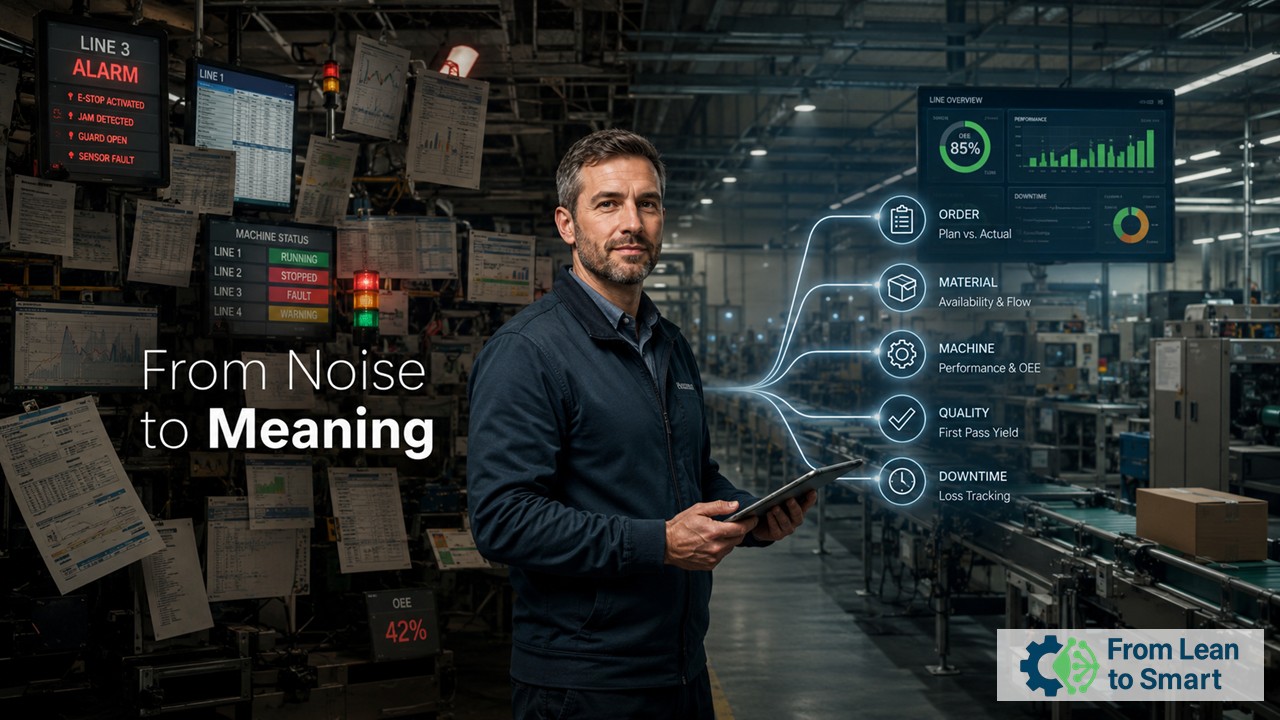
Many factories do not lack data. They lack operational meaning.
They have machine signals, production reports, Excel files, alarms, quality records, maintenance notes, ERP transactions, operator comments and dashboards. Yet when a line stops, a batch deviates, a schedule slips or a customer complaint arrives, people still spend hours asking the same questions:
What really happened?
When did it happen?
Which order, material, operator, machine, tool, batch or shift was involved?
Was this an isolated incident or part of a pattern?
Did anyone act on it?
This is the gap where MES/MOM becomes relevant.
Not because MES/MOM is another system to add to the stack. Not because digital transformation sounds attractive. And not because collecting more data automatically improves performance.
MES/MOM matters when it helps a factory move from isolated shopfloor noise to operational intelligence: information that is connected to process context, trusted by people and used to make better decisions.
The core idea
The main purpose of MES/MOM is not to display what is happening in the factory. Its real purpose is to help manage manufacturing operations with more discipline, visibility and evidence.
A production plant is full of events. A machine starts. A machine stops. A material is consumed. A batch is released. A quality check fails. A work order is delayed. A maintenance intervention takes longer than expected. A changeover does not follow the standard. A supervisor changes the sequence. An operator records a reason code.
Individually, these events are just fragments.
MES/MOM creates value when those fragments are connected into an operational story:
The planned order was this.
The actual execution was that.
The loss happened here.
The reason was recorded there.
The material came from this lot.
The quality impact was this one.
The decision taken was that one.
This is not software magic. It is operational discipline supported by technology.
Many companies make the mistake of approaching MES as a visibility project. They want screens, dashboards, real-time indicators and automatic reports. Those things can be useful, but they are not the foundation. A dashboard showing poor data faster is still poor data. A real-time OEE number without reliable context can create more confusion than improvement.
The real question is not: “Can we see the factory in real time?”
The better question is: “Can we understand what is happening well enough to act correctly?”
The concept explained in plain English
MES stands for Manufacturing Execution System. MOM stands for Manufacturing Operations Management.
In simple terms, MES is usually associated with managing and recording the execution of production: work orders, operations, material consumption, machine status, labor, quality checks, downtime and traceability.
MOM is broader. It refers to the management of manufacturing operations as a whole, including production, quality, maintenance, inventory movements, performance management and the coordination of people, equipment, materials and methods.
A useful way to see it is this:
ERP decides what the business needs.
The shopfloor executes what physically happens.
MES/MOM connects the two realities.
ERP may know that order 4500123 must be produced this week. The PLC knows whether a motor is running. SCADA may show a temperature, pressure or speed. A historian may store thousands of process values.
But none of those things alone tells the complete operational story.
MES/MOM provides the context that turns signals into manufacturing information. It connects production orders with equipment, materials, operators, recipes, quality results, downtime reasons and actual performance.
That context is what allows people to answer practical questions:
Are we producing the right thing?
Are we following the right method?
Are we using the right material?
Are we within quality limits?
Are we losing time for a known reason?
Are we creating traceability evidence?
Are we learning from repeated losses?
Without this context, the plant may be highly automated and still poorly understood.
Where it fits in the MES/MOM architecture
MES/MOM normally sits between business systems and control systems.
At the business level, ERP manages commercial demand, planning, purchasing, finance, inventory valuation and customer commitments. It is essential, but it is not designed to understand every operational event on the line.
At the control level, PLCs, SCADA and HMI systems control and monitor machines, lines and processes. They are close to the equipment and often very fast, but they usually do not manage the full business and operational context of production.
MES/MOM lives in the operational layer between them.
It receives production requirements from ERP and translates them into executable shopfloor activities. It receives signals and events from machines, operators and systems, then organizes them around manufacturing context: order, operation, product, material, batch, equipment, shift, personnel, quality status and time.
It may exchange information with many other systems:
With WMS, it coordinates material availability and consumption.
With QMS or LIMS, it connects quality checks, laboratory results and release decisions.
With CMMS or EAM, it links downtime, maintenance work and asset reliability.
With historians, it enriches process signals with production context.
With BI or analytics platforms, it provides structured operational data for reporting and decision-making.
Technologies such as OPC UA, MQTT, Sparkplug, edge platforms, cloud services and IIoT can support this connectivity. But connectivity is not enough. A factory can connect thousands of tags and still not know why performance is poor.
The architecture only creates value when the data has ownership, meaning and use.
Why it matters for Operational Excellence
Operational Excellence depends on seeing losses clearly and acting on them consistently.
MES/MOM can support this, but only when it is connected to real improvement routines.
For OEE, it can help distinguish availability, performance and quality losses. But the number itself is less important than the ability to understand the loss structure behind it.
For downtime, it can help capture events and reason codes. But reason codes only matter if they are reliable enough to drive action.
For quality, it can connect defects, rework, scrap, process parameters, materials and operators. But quality data must be used to prevent recurrence, not just to produce reports after the fact.
For traceability, it can connect material lots, batches, equipment, process steps and finished goods. But traceability must be designed around real risk and customer requirements, not around collecting everything without purpose.
For cost per unit, MES/MOM can provide the operational facts behind labor usage, yield, scrap, cycle time, changeover loss and downtime. But cost insight only matters when operations, finance and engineering use the same operational truth.
In Lean, TPM and continuous improvement environments, MES/MOM can strengthen standard work, daily management, abnormality management and root cause analysis. But it cannot replace leadership discipline. It cannot make people act on problems they choose to ignore.
This is why MES/MOM should be seen as an operational capability, not an IT installation.
Typical mistakes and anti-patterns
One common mistake is treating MES as a dashboard project.
The factory gets screens, charts and alerts, but the underlying process remains unclear. Nobody agrees on downtime definitions. Operators do not trust reason codes. Supervisors still use side spreadsheets. Maintenance does not receive useful failure context. Quality data is captured too late. ERP orders do not match shopfloor reality.
The result is visibility without control.
Another mistake is connecting systems before defining meaning. Companies integrate ERP, machines, historians and reporting tools, but they do not define what a production order means operationally, how equipment should be structured, who owns master data or how exceptions should be handled.
This creates a digital version of the same confusion.
A third anti-pattern is assuming MES will impose discipline by itself. It will not. If the plant has weak standards, poor master data, unclear responsibilities and no daily management routine, MES may expose the problem, but it will not solve it automatically.
There is also a growing temptation to jump directly into AI, advanced analytics or predictive dashboards before establishing reliable operational context. This is risky. Algorithms built on inconsistent downtime reasons, incomplete material genealogy or poorly structured equipment data may look sophisticated, but they will not support robust decisions.
The most damaging mistake is buying software before understanding the operating model.
A good MES/MOM project starts on the gemba, not in a conference room. It starts by understanding how production is actually planned, executed, interrupted, corrected, measured and improved.
Practical industrial example
Consider a packaging line in a food manufacturing plant.
The ERP system sends production orders for different SKUs. The PLCs control conveyors, fillers, labelers and case packers. The SCADA shows machine status and alarms. Operators record some information manually. Maintenance logs interventions in a separate system. Quality checks are recorded in another file.
On paper, the plant has data everywhere.
But during the daily meeting, the team still debates why yesterday’s output was below target. Operations says the issue was maintenance. Maintenance says the machine was available but blocked by material shortages. Quality says several checks were repeated because of labeling deviations. Planning says the order sequence changed three times. Operators say the main problem was changeover complexity.
Everyone is partly right. Nobody has the full picture.
A well-designed MES/MOM capability would not magically eliminate all losses. But it could connect the production order, SKU, changeover, equipment status, downtime events, reason codes, quality checks, material availability and actual output into one operational record.
The daily conversation would change.
Instead of arguing about what happened, the team could focus on what to improve:
Which SKUs create the longest changeovers?
Which downtime reasons repeat by equipment and shift?
Which quality deviations are linked to specific materials or settings?
Which schedule changes create avoidable losses?
Which standards are not followed because they are unclear or impractical?
This is the shift from noise to intelligence.
Not more data. Better context.
Implementation checklist
Before implementing this capability, check whether…
Your plant has a shared definition of the main operational losses.
Production orders, equipment, materials and operations are structured in a way that reflects shopfloor reality.
Operators understand why data is being captured and how it will be used.
Downtime reason codes are simple enough to be used correctly but detailed enough to support action.
ERP master data is validated against the real manufacturing process.
Quality, maintenance, production and planning agree on the key events that must be captured.
Dashboards are designed around decisions, not around everything that can be measured.
There is a routine to review MES/MOM data and convert it into improvement actions.
Data ownership is clear between operations, engineering, maintenance, quality and IT.
The first implementation scope is small enough to create learning before scaling.
1. Does your factory really lack data, or does it lack shared operational meaning?
One possible way to look at it is that many factories already capture many signals, but those signals are not always connected to order, material, equipment, quality, people and time. Without that context, more data does not necessarily mean better decisions.
2. Are your dashboards helping people make better decisions, or are they just making factory noise more visible?
In many factories, dashboards become valuable only when they support a clear management routine. A screen that shows losses is useful only if the organization knows who reacts, how fast, with what authority and with what follow-up.
3. Where is the biggest gap today: shopfloor data capture, process discipline, system integration or decision-making routines?
A useful starting point could be to follow one real production loss from detection to decision. That path often shows whether the weak point is the data source, the process definition, the system connection or the way teams act on information.
#MES #MOM #Manufacturing #OperationalExcellence #SmartManufacturing #Industry40 #DigitalTransformation #ITOT #DataDrivenManufacturing #IndustrialAutomation #LeanManufacturing #OEE #ProcessImprovement