There comes a moment in the life of anyone seriously affected by continuous improvement when a dangerous line is crossed.
First, you apply 5S on a production line.
Then you organize a tool room.
Then you start reviewing information flows across a factory.
And one day, without even realizing it, you find yourself standing in your kitchen, looking at the dishwasher as if it were a critical production station with a traceability problem.
That is when you know there is no way back.
Maybe those of us who love operational excellence have some kind of industrial obsessive-compulsive tendency. Not in a clinical sense, of course. More in that suspicious domestic sense of looking at a messy drawer and thinking:
“This needs a visual standard.”
And the worst part is that, most of the time, we are right.
The Problem: The Invisible State of the Dishwasher
The case was simple.
Several people at home use the dishwasher. Nothing particularly revolutionary there.
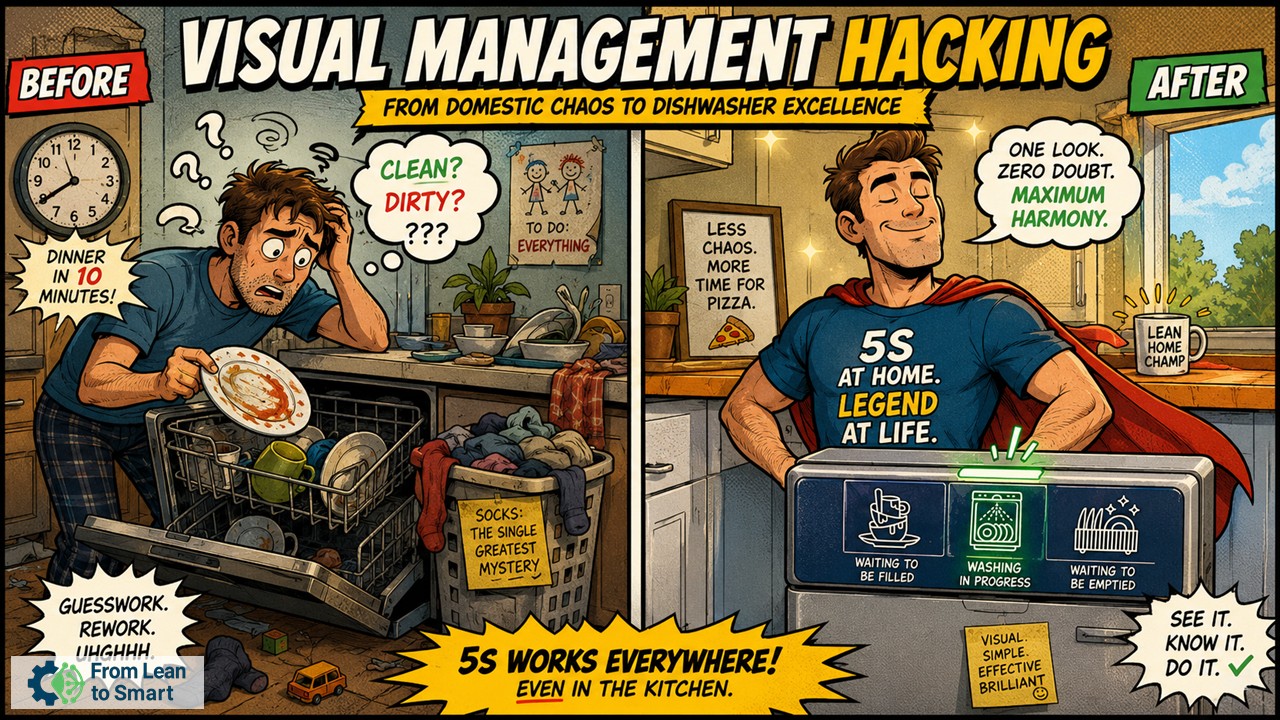
The problem appeared when someone opened it and faced one of the great existential questions of modern life:
Is this clean or dirty?
Sometimes, it is not obvious.
Yes, you can pick up a glass, check it against the light, inspect the surface, look for tiny food particles, analyze the smell, and make an evidence-based decision.
But that requires time, attention, and a calm mind.
And real life does not always offer those conditions.
Sometimes you open the dishwasher in a hurry, half awake, thinking about something else, while someone is asking where the keys are, the coffee is still unfinished, and a piece of toast is burning quietly in the background.
In that context, the probability of error increases.
And the typical error was painful: putting dirty items into a dishwasher that was already clean.
A two-second decision capable of contaminating an entire clean load.
In domestic-industrial terms, we are talking about a quality failure, rework, waste of water, energy, detergent, and a certain amount of interpersonal tension.
A textbook nonconformity.
The Solution: Visual Management Hacking
The idea was almost embarrassingly simple.
I installed a visual selector with three states:
- Waiting to be filled with dirty items.
- Washing in progress.
- Waiting to be emptied of clean items.
That is it.
No mobile app.
No Alexa integration.
No Power BI dashboard.
No IoT sensors.
No predictive algorithm.
No 100-layer neural network combining the washing cycle with ambient humidity, the Greenwich meridian, and the emotional position of the family towards the small fork.
Just a simple visual selector.
And it works.
A Home Full of Small Operational Inventions
I should admit something: this is not an isolated case.
My house is full of small inventions like this.
Visual signals, logical locations, unsolicited domestic standards, and systems that probably only someone with too many Lean hours behind them could consider normal.
I do not show them all for reasons of public safety.
An overdose of operational nerdiness may not be recommended for the general population.
And here, there is another key part of the system that deserves recognition: the love and patience of a partner like mine are priceless.
Because one thing is accepting that someone has strange hobbies.
Another very different thing is living with someone who looks at a domestic problem and thinks:
“This can be solved with Visual Management.”
She accepted me as I am.
And honestly, that has more merit than any Lean Six Sigma certification.
Is It a Perfect Poka-Yoke?
No.
From a purist perspective, this is not a perfect poka-yoke because it does not physically prevent the error 100% of the time.
Someone could move the selector incorrectly.
Someone could forget to update it.
Someone could simply ignore it.
But here comes an important lesson: useful solutions do not always need to be perfect.
In continuous improvement, we are often not looking for the most sophisticated solution.
We are looking for the cheapest, fastest, clearest, and most practical solution capable of reducing the problem dramatically.
Before, there was ambiguity.
Now, there is a shared visual standard.
Before, every person had to interpret the state of the system.
Now, the system communicates its state.
Before, we depended on memory, attention, and luck.
Now, we depend on a simple visual signal.
And that, even if imperfect, is already a major improvement.
5S Is Not About Tidiness. It Is About Reducing Friction.
5S is often misunderstood as “putting labels everywhere” or “making things look nice.”
But 5S is not about aesthetics.
It is about creating environments where doing the right thing is easier than doing the wrong thing.
In a factory, that may mean marked tools, delimited areas, identified materials, clear routes, visible equipment status, or standardized workstations.
In a kitchen, it may mean knowing whether the dishwasher is clean or dirty without launching a forensic investigation.
The logic is the same.
Seiri: sort.
Seiton: set in order.
Seiso: shine and inspect.
Seiketsu: standardize.
Shitsuke: sustain.
My dishwasher has not yet received a formal 5S audit.
Yet.
But it now has something powerful: a simple visual rule that everyone can understand.
Visual Management: When the System Speaks Before You Ask
Good Visual Management has one key feature: it reduces the need to ask.
You should not need to ask whether a machine is stopped, whether material is pending, whether a tool is missing, or whether a task has been completed.
The environment should tell you.
In the dishwasher case, the recurring question was always the same:
“Is it clean?”
And when the same question keeps appearing again and again, we are probably not facing a human communication problem.
We are facing a system design problem.
Improvement is not telling people:
“Pay more attention.”
That rarely works.
Improvement is changing the system so that paying attention becomes easier.
The Shortest Learning Curve in the World
The implementation was highly sophisticated.
Launch meeting: 30 seconds.
User training: 15 seconds.
Change management: looking seriously at whoever failed to move the selector.
Process audit: random visual inspection during the week.
Main KPI: reduction of clean/dirty dishwasher cross-contamination incidents.
Result: almost immediate improvement.
After a very short learning curve, the problem practically disappeared.
And this is the beauty of small improvements: they do not require a massive cultural transformation.
They just require a solution so obvious that the system starts working better almost by itself.
The Technology Temptation
Of course, we could make it more complicated.
We could install door sensors.
We could measure the temperature of the last cycle.
We could connect the dishwasher to an app.
We could generate automatic notifications.
We could create a digital twin of the appliance.
We could develop an AI model to classify dish status based on humidity, brightness, dish position, cycle history, and residual coffee traces.
We could.
But no.
Not every problem needs a platform.
Not every workflow needs blockchain.
Not every standard needs artificial intelligence.
And not every dishwasher needs to become a smart factory.
Sometimes, a simple three-state visual signal wins by a landslide.
The Real Lesson
Operational excellence does not start in a boardroom.
It starts when someone sees a repeated friction point and decides to remove it.
It can happen in a factory, in a warehouse, in an office, or in a kitchen.
The principle is the same:
If the state of a process is not visible, someone will have to guess.
And when someone has to guess, sooner or later, they will make a mistake.
That is why I like to call this Visual Management Hacking: small visual hacks that make life easier, reduce errors, and turn chaotic processes into slightly smarter systems.
Yes, maybe those of us who do this have a small obsession with order, standards, and continuous improvement.
Maybe.
But if that obsession prevents someone from putting a tomato-stained plate into a freshly cleaned dishwasher, I will defend it.
Proudly.
And with the selector in the right position.
Reflection Questions
- How many daily problems are not really people problems, but visibility problems?
- How often do we try to solve with technology what could first be solved with a simple standard?
- What is the “dishwasher problem” in your workplace or daily life that could be improved with better Visual Management?
#OperationalExcellence #LeanManufacturing #5S #VisualManagement #ContinuousImprovement #ProcessImprovement #Kaizen #PokaYoke #LeanThinking #SmartFactory