
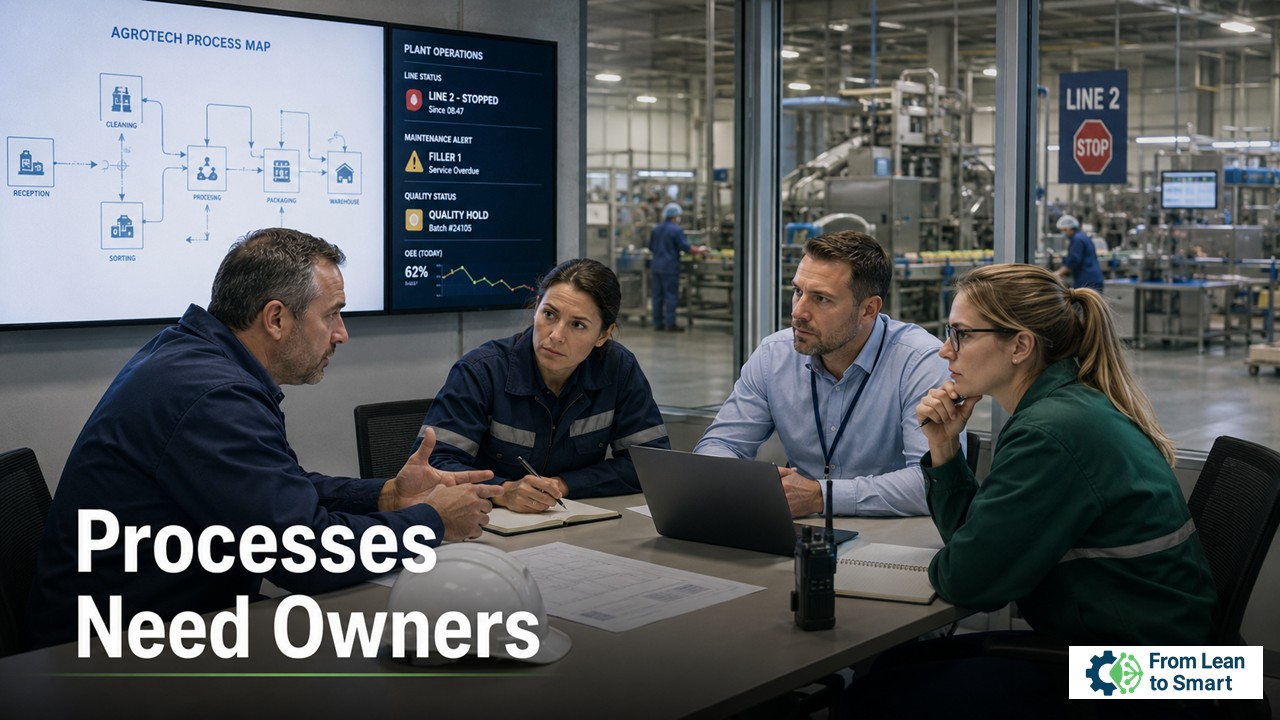
A process does not truly govern work until it defines who owns the outcome.
Many organizations have processes.
They have process maps, repositories, procedures, workflows, dashboards, KPIs, approval matrices and governance meetings.
Everything looks controlled.
Until something goes wrong.
Then the real question appears:
Who is accountable?
Not who was informed.
Not who attended the meeting.
Not who owns a box in the diagram.
Not who has a name in the process repository.
Who is accountable for the operational outcome?
This is where many BPM initiatives become fragile.
They define the process, but not the responsibility behind the process.
They document the flow, but not the decision rights.
They assign ownership, but not the authority to change conditions.
They create visibility, but not consequence.
And when accountability is missing, BPM becomes theatre.
A process without accountability does not govern work.
It only describes how work should happen.
That difference is critical.
Especially in industrial environments.
When reality tests the process
On the shopfloor, processes are tested under pressure.
A line stops.
A quality deviation appears.
A critical spare part is missing.
Production wants to recover volume.
Maintenance needs downtime.
Planning changes priorities.
Engineering is still investigating the root cause.
Logistics is trying to protect the customer shipment.
In that moment, the organization does not need a beautiful process map.
It needs clarity.
Who decides?
Who accepts the risk?
Who escalates?
Who has the authority to stop?
Who can override the standard path?
Who records the decision?
Who follows up after the incident?
If the process cannot answer these questions, it is incomplete.
Many BPM models are strong on activity sequencing and weak on accountability.
They show what happens first, second and third.
They show roles involved.
They may even show system transactions, approvals and escalation steps.
But operational accountability is not the same as participation.
A maintenance technician can execute an intervention without owning the reliability strategy.
A production supervisor can escalate a downtime issue without owning the asset condition.
A quality engineer can block a batch without owning the production recovery plan.
A planner can reschedule orders without owning the root cause of instability.
Everyone touches the process.
But no one owns the end-to-end consequence.
That is how processes become fragmented.
Local logic can still create system failure
In many organizations, each function can explain its behavior.
Purchasing followed the procurement policy, but the spare part was still late.
Maintenance followed the work order process, but the failure repeated.
Quality followed the containment procedure, but the decision took too long.
Production followed the schedule, but the plan was already unrealistic.
Individually, everyone can defend their logic.
Collectively, the process fails.
This is not a documentation problem.
It is a governance problem.
In real operations, accountability must live where trade-offs happen.
And trade-offs happen constantly.
Safety versus output.
Quality versus delivery.
Availability versus maintainability.
Efficiency versus flexibility.
Inventory versus service level.
Speed versus risk.
Standardization versus local adaptation.
A process that ignores these trade-offs is only a simplified version of reality.
A serious BPM approach must define how trade-offs are managed, who has the authority to decide and how decisions are made visible.
Otherwise, the organization creates a dangerous illusion:
The process appears governed, but the real decisions happen elsewhere.
In escalation calls.
In corridor conversations.
In WhatsApp messages.
In shift handovers.
In informal agreements between experienced people.
In exceptions that are closed but never truly understood.
That is where accountability disappears.
Not because people are irresponsible.
But because the system has not made responsibility explicit enough.
A process owner without authority is not a real owner
There is a common mistake in BPM:
Assigning a process owner and assuming accountability is solved.
It is not.
A process owner without authority is a coordinator.
A process owner without data is a spectator.
A process owner without cross-functional influence is an administrator.
A process owner without operational connection is a title.
Real process ownership requires more than a name in a governance chart.
It requires the ability to challenge performance, change standards, resolve conflicts, influence system design, align KPIs and force learning from deviations.
That is uncomfortable.
Which is why many organizations avoid it.
They prefer process governance that is polite, formal and non-confrontational.
Meetings are held.
Actions are assigned.
Minutes are written.
Dashboards are reviewed.
But the real conflicts remain unresolved.
Production still protects output.
Maintenance still fights for planned downtime.
Quality still escalates late risks.
Planning still absorbs instability.
Engineering still receives problems after they have already become urgent.
Everyone is busy.
The process remains weak.
This is why BPM without accountability often becomes administrative theatre.
It creates the appearance of control without changing the management behaviors that produce instability.
Digital tools expose accountability gaps faster
The same problem appears in digital transformation.
A company implements a workflow tool, an MES/MOM module, a maintenance system or a Process Mining platform.
The expectation is that digitalization will bring discipline.
Sometimes it does.
But technology cannot create accountability where the organization has avoided it.
A workflow can route a task.
It cannot make an unclear owner take responsibility.
A dashboard can show a delay.
It cannot decide who must remove the cause.
An MES can capture production execution.
It cannot resolve a conflict between schedule pressure and quality risk.
Process Mining can expose variants.
It cannot force leaders to govern the process.
Systems make accountability visible.
They do not replace it.
In fact, digital tools often reveal accountability gaps faster.
Once the process becomes transparent, people can no longer hide behind lack of information. The organization starts to see where cases wait, where decisions repeat, where approvals add no value, where exceptions accumulate and where ownership is ambiguous.
That visibility can be powerful.
But only if leaders are willing to act on it.
Otherwise, digital BPM becomes a better stage for the same theatre.
The dashboard improves.
The behavior does not.
The four levels of process accountability
In industrial operations, accountability must be designed into the process at several levels.
1. Accountability for execution
This is the basic level.
Are activities performed as expected?
Are standards followed?
Are records completed?
Are checks done correctly?
Are deviations reported?
This matters.
But it is not enough.
A process can be executed correctly and still fail as a system.
2. Accountability for decisions
This is where many processes become unclear.
Who decides when the standard path cannot be followed?
Who approves temporary deviations?
Who accepts operational risk?
Who defines escalation thresholds?
Who decides when a workaround is no longer acceptable?
If these questions are not answered, people will still make decisions.
They will just make them outside the process.
3. Accountability for performance
Someone must own the end-to-end result.
Not only the departmental KPI.
The process outcome.
Lead time.
Stability.
Quality.
Reliability.
Delivery.
Cost.
Service.
Learning.
Without this level, functions optimize locally while the total process remains weak.
4. Accountability for improvement
Who ensures the process gets better after recurring deviations?
Who removes root causes?
Who updates standards?
Who changes system logic?
Who prevents the same exception from becoming normal?
A process that does not learn is not managed.
It is repeated.
When exceptions become routine
Many organizations normalize recurring problems because accountability is spread too thin.
Every week, the same material shortages.
Every month, the same quality escalations.
Every shift, the same equipment instability.
Every planning cycle, the same firefighting.
Every audit, the same procedural gaps.
People become used to it.
The process absorbs the pain.
But acceptance is not maturity.
If a deviation repeats, it is no longer an exception.
It is part of the real process.
And if it is part of the real process, someone must own it.
This is where BPM should become sharper.
Not more bureaucratic.
Sharper.
It should expose where responsibility is unclear.
It should make decision rights explicit.
It should connect process performance with management routines.
It should clarify what can be decided locally, what must be escalated and what must trigger structural improvement.
A good BPM conversation should sometimes be uncomfortable.
Because real accountability is uncomfortable.
It forces the organization to admit that some problems are not caused by lack of procedures.
They are caused by weak ownership, conflicting KPIs, unclear authority or leadership tolerance for recurring instability.
That is not solved by adding another swimlane.
It is solved by changing how the organization governs work.
The breakdown process may work while reliability fails
Consider a recurring machine breakdown.
The standard process may work perfectly.
The operator reports the failure.
Maintenance responds.
The line restarts.
The work order is closed.
Execution happened.
But if the same failure returns every week, the process is not healthy.
Execution happened.
Accountability did not.
Someone must own the recurring loss.
Someone must connect breakdown history, spare parts, maintenance strategy, production constraints, operator practices and engineering support.
Someone must decide whether the issue requires redesign, condition monitoring, preventive maintenance adjustment, training or capital investment.
If no one owns that cross-functional decision, the organization will continue to execute the breakdown process efficiently.
Again and again.
This is one of the hidden dangers of process efficiency:
Doing the wrong cycle faster.
BPM should not only help the organization execute.
It should help the organization stop repeating avoidable pain.
That requires accountability beyond task completion.
The same applies to quality deviations.
Closing a nonconformity in the system is not the same as owning the quality risk.
Assigning corrective actions is not the same as ensuring the process changed.
Approving a deviation is not the same as understanding why the deviation was necessary.
The transaction is not the responsibility.
The responsibility is the outcome.
From documentation to ownership
This is the mindset shift industrial BPM needs.
From process documentation to process ownership.
From workflow compliance to decision accountability.
From local optimization to end-to-end performance.
From closing tasks to learning from operational reality.
This shift is not glamorous.
It does not sound as exciting as AI, automation or digital twins.
But without it, those technologies rest on a weak foundation.
AI will not fix unclear ownership.
Automation will not fix conflicting priorities.
Process Mining will not fix leadership avoidance.
MES/MOM will not fix accountability gaps unless the operating model is ready to use them.
The future of operational transformation depends on this discipline.
Because factories do not fail only because processes are missing.
They often fail because processes exist, but responsibility is diluted.
Everyone is involved.
Everyone is informed.
Everyone is aligned in principle.
But when reality becomes difficult, no one clearly owns the decision.
That is the moment where BPM must prove its value.
Not in the repository.
Not in the workshop.
Not in the governance slide.
But in the operational moment where the process needs:
An accountable human being.
A clear decision.
A visible trade-off.
A follow-up that prevents recurrence.
Without that, BPM is theatre.
Professional theatre, perhaps.
Well-documented theatre.
Digitally enabled theatre.
But theatre nonetheless.
Real BPM starts when the organization stops asking only:
“What is the process?”
And starts asking the harder question:
“Who is accountable for making this process work when reality does not cooperate?”
That is where BPM stops being documentation.
And starts becoming operational governance.
#BPM #OperationalExcellence #ProcessGovernance #ProcessOwnership #SmartFactory #ProcessMining #ManufacturingOperations #IndustrialTransformation