Why the real value of AI in manufacturing is better operational decision-making
Industrial AI is often presented as a prediction engine.
Predict failures earlier.
Predict defects before they escape.
Predict demand changes.
Predict process deviations.
Predict energy peaks.
Predict downtime risk.
And yes, prediction matters.
In industrial environments, seeing a problem earlier can create real value.
But prediction is not the end of the story.
In factories, the real value of AI does not come from knowing something sooner.
It comes from making a better decision with that knowledge.
That distinction sounds simple.
But it changes almost everything.
A prediction is a signal.
A decision is a commitment.
And operations are not improved by signals alone.
The Gap Between Knowing and Acting
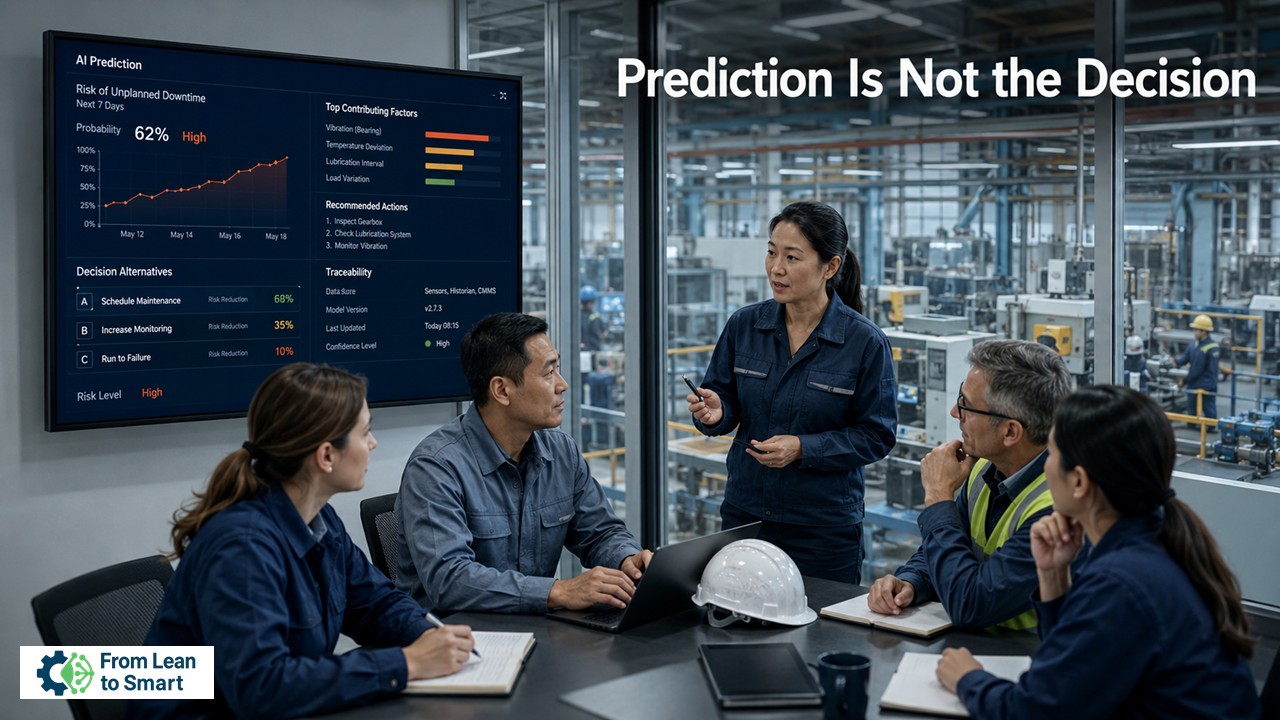
Imagine that a model predicts an increasing probability of failure on a critical asset.
What should the factory do?
Stop the line now?
Wait until the next planned maintenance window?
Reduce load?
Prepare spare parts?
Run additional inspections?
Accept the risk until the current production campaign is finished?
The right answer depends on context:
Production priorities.
Safety exposure.
Customer commitments.
Spare parts availability.
Maintenance capacity.
Asset criticality.
Quality risk.
Confidence level of the diagnosis.
The AI model may provide evidence.
But the organization still has to decide.
This is where many industrial AI initiatives become fragile.
They focus on improving the prediction, but they do not design the decision process around the prediction.
The result is familiar:
More alerts.
More dashboards.
More discussions.
More “interesting insights”.
Not enough operational change.
In real factories, the bottleneck is often not the lack of information.
It is the lack of governed decision-making.
Prediction Without Context Creates Operational Noise
Factories already have many signals.
Machine alarms.
MES events.
SCADA data.
Quality alerts.
Maintenance notifications.
OEE losses.
Operator comments.
Planner changes.
Supplier deviations.
Customer escalations.
Adding AI-generated predictions to this environment can be powerful.
But it can also create another layer of noise.
A predicted defect pattern is not useful if nobody connects it to material batches, process parameters, recipes, tooling conditions, containment rules and customer risk.
A predicted maintenance risk is not useful if the organization cannot prioritize the intervention against the production plan, maintenance backlog and asset criticality.
A predicted bottleneck is not useful if decision rights between production, logistics, engineering and planning are unclear.
The question is not only:
“Can the model detect the signal?”
The harder question is:
“Can the factory convert the signal into a responsible action?”
That is where the real maturity test begins.
The Real Unit of Value Is the Decision
Industrial AI should be evaluated by the decisions it improves.
Does it help prioritize work better?
Does it reduce the time needed to understand an abnormality?
Does it improve the quality of escalation?
Does it make trade-offs more explicit?
Does it reduce hidden operational risk?
Does it help teams learn from repeated patterns?
Does it make decisions more traceable?
If the answer is yes, AI is creating operational value.
If the answer is no, the organization may simply be building a more sophisticated reporting layer.
This is a common trap.
A dashboard can show a prediction and still fail to improve the decision.
A model can be accurate and still be operationally irrelevant.
An AI assistant can generate a reasonable recommendation and still be unsafe if it is not bounded by procedures, constraints and accountability.
Industrial AI is not valuable because it is intelligent in isolation.
It is valuable when it improves the intelligence of the operating system.
Better Decisions Require Operational Context
A factory decision rarely depends on one variable.
A maintenance recommendation depends on asset condition, failure mode, spare parts, safety, production impact, intervention time, skill availability and historical behavior.
A quality recommendation depends on process parameters, genealogy, tolerance rules, customer requirements, containment criteria and the cost of false release versus false rejection.
A production recommendation depends on takt, changeover capability, material flow, labor flexibility, equipment status and planning constraints.
This is why industrial AI cannot be separated from the systems and routines that shape daily operations:
MES/MOM.
CMMS/EAM.
ERP.
QMS.
SCADA.
Historians.
Master data.
Shopfloor routines.
AI needs context.
Not just data.
Context means understanding what the data represents, where it comes from, how reliable it is, what decision it supports, who owns it and what constraints apply before action is taken.
Without that context, predictions remain technically impressive but operationally weak.
Decision Intelligence Is Not Automation Without People
Some organizations interpret AI maturity as moving toward full automation.
In factories, that is often the wrong ambition.
The most valuable industrial decisions are not always the ones that can or should be fully automated.
They are often the ones that need faster reasoning, better prioritization, clearer escalation and stronger traceability.
Human-in-the-loop is not a sign of immaturity.
In industrial environments, it is often a governance requirement.
Operators, supervisors, maintenance technicians, quality engineers, planners and managers carry contextual knowledge that is not always visible in the data.
They understand temporary constraints, recent changes, weak signals, informal adaptations and the operational consequences of a wrong decision.
AI should not bypass that knowledge.
It should help structure it, challenge it, enrich it and make it more traceable.
The future is not AI replacing operational judgment.
The future is AI improving operational judgment under governance.
From Alert to Decision: Where Value Really Appears
Imagine a quality model detecting an increased probability of surface defects after a process parameter drift.
A weak AI implementation stops at the alert:
“Risk of defect detected.”
A stronger implementation connects the alert with the production order, material batch, machine condition, recipe version, previous similar cases, inspection results, customer risk and containment rules.
But a mature implementation goes further.
It supports the decision.
Should production continue with additional inspection?
Should the batch be held?
Should parameters be adjusted?
Should engineering review the recipe?
Should maintenance check the equipment condition?
Should customer risk be escalated?
What evidence justifies the decision?
Who approved it?
What happened after the action?
This is where value appears.
Not in the prediction alone, but in the governed path from prediction to decision to action to learning.
Industrial AI Needs a Decision Architecture
If organizations want AI to scale beyond pilots, they need to define the decision architecture around it.
That means clarifying:
What decision is being improved.
Who owns the decision.
What evidence is required.
What constraints must be respected.
What alternatives should be compared.
What level of human review is needed.
What must be recorded for traceability.
How outcomes are reviewed and learned from.
This is not bureaucracy.
It is the operating discipline that makes AI usable in real industrial conditions.
Without it, AI remains a technical capability searching for an operational home.
With it, AI becomes part of the management system.
The Uncomfortable Shift
The industrial AI conversation needs to move from:
“What can AI predict?”
to:
“What decisions can AI help us make better?”
That shift is uncomfortable because it exposes deeper issues.
Unclear ownership.
Weak master data.
Disconnected systems.
Poor escalation logic.
Unstable standards.
Informal prioritization.
Decision-making driven by hierarchy instead of evidence.
AI does not hide these problems.
It reveals them.
That is why mature organizations will not treat AI as a shortcut around operational discipline.
They will use AI as a way to strengthen it.
Because the real value of industrial AI is not prediction.
It is better decisions:
Faster when needed.
Slower when necessary.
Clearer in ownership.
Richer in context.
More traceable over time.
AI does not create value by predicting the future.
It creates value when it improves the decisions that shape it.
Questions for Reflection
Which AI initiatives in our factory are clearly linked to a decision, not only to a prediction, alert or dashboard?
Do we know who owns the decision when an AI model recommends action under operational pressure?
Are we measuring AI success by model performance, or by the quality, speed and traceability of the decisions it improves?
#IndustrialAI #DecisionIntelligence #AIInManufacturing #SmartFactory #OperationalExcellence #DataGovernance #Manufacturing #MES #MOM #AssetManagement #Reliability #HumanInTheLoop #IndustrialTransformation #ManufacturingExcellence